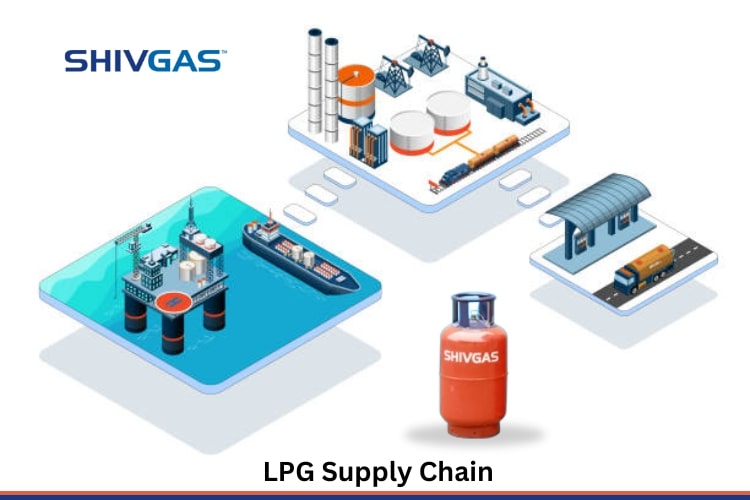
A distributor cannot treat LPG supply as a simple stock-and-delivery operation. The performance of an LPG supply chain depends on how well the business manages procurement, inventory, storage, transportation, cylinder handling and final delivery as one connected system.
A disruption at any stage can affect the next. Poor inventory planning can delay dispatches. Weak storage practices can create safety risks. Inefficient routing can increase delivery time and operating costs. Inadequate staff training can lead to handling errors.
For an LPG distribution business, supply-chain optimization therefore comes down to operational control. The objective is to maintain a reliable supply of LPG, meet demand, control inventory and comply with the safety requirements that govern LPG handling and storage.
The challenges vary from one distribution operation to another, but transportation, storage, inventory management, technology and safety remain common areas of concern.
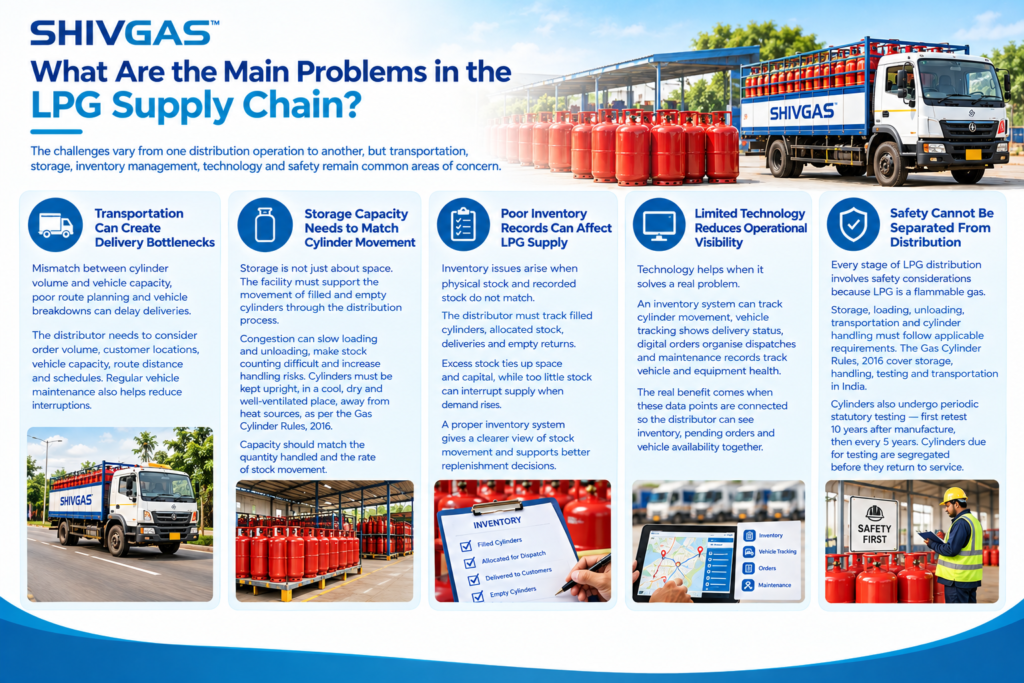
Transportation becomes difficult when the number of cylinders to be delivered does not match available vehicle capacity or route planning.
A distributor may have enough LPG in stock, but that stock cannot serve customers until the cylinders reach the delivery points. Poor route planning can result in partially loaded vehicles, unnecessary kilometres and multiple trips to the same area. Vehicle breakdowns can create another problem by disrupting the delivery schedule for the rest of the day.
The distributor therefore needs to consider order volume, customer locations, vehicle capacity, route distance and delivery schedules together. Regular vehicle inspection and maintenance also help reduce avoidable interruptions to the distribution cycle.
Storage is not only about having enough floor space for cylinders. The facility needs to accommodate the movement of filled and empty cylinders through different stages of the distribution process.
A congested storage area can slow down loading and unloading, make stock counting difficult and increase the possibility of poor handling. The layout also needs to support safe access for employees and vehicles.
The Gas Cylinder Rules, 2016 require LPG cylinders to be kept upright and positioned so they cannot be knocked over. The rules also specify that cylinders should be stored in a cool, dry and well-ventilated place, away from potential sources of heat.
Storage capacity should therefore be assessed against both the quantity of cylinders handled and the rate at which stock enters and leaves the facility.
Inventory problems can emerge when physical stock and recorded stock do not match.
A distributor needs to know how many filled cylinders are available, how many have been allocated for dispatch, how many have reached customers and how many empty cylinders have returned. Without this information, replenishment decisions become difficult.
Maintaining excess stock ties up storage space and working capital. Holding too little stock can interrupt the supply of LPG when customer demand rises.
A proper inventory system gives the distributor a clearer picture of stock movement and makes replenishment decisions less dependent on guesswork.
Technology is useful when it solves a specific distribution problem.
An inventory management system can record cylinder movement. Vehicle tracking can show the status of deliveries. Digital order records can help the distributor organise dispatches according to customer demand. Maintenance records can also provide a history of vehicle and equipment performance.
The benefit comes from connecting this information. If a distributor can see inventory, pending orders and vehicle availability together, it becomes easier to identify where a delivery cycle may fall short.
Technology cannot replace trained employees or proper operating procedures. It works best when it gives the people managing the operation accurate information at the right time.
Every stage of LPG distribution involves safety considerations because LPG is a flammable gas.
Storage, loading, unloading, transportation and cylinder handling must follow the applicable requirements. The Gas Cylinder Rules, 2016 provide the regulatory framework covering several aspects of gas cylinder storage, handling, testing and transportation in India.
Cylinder condition also matters. The Ministry of Petroleum and Natural Gas states that LPG cylinders undergo periodic statutory testing, with the first retest 10 years after manufacture and subsequent testing at five-year intervals. Cylinders due for testing are segregated before they return to service.
A stronger supply chain starts with better coordination between supply, inventory, storage and delivery. The distributor does not need to optimize one area while ignoring the others.
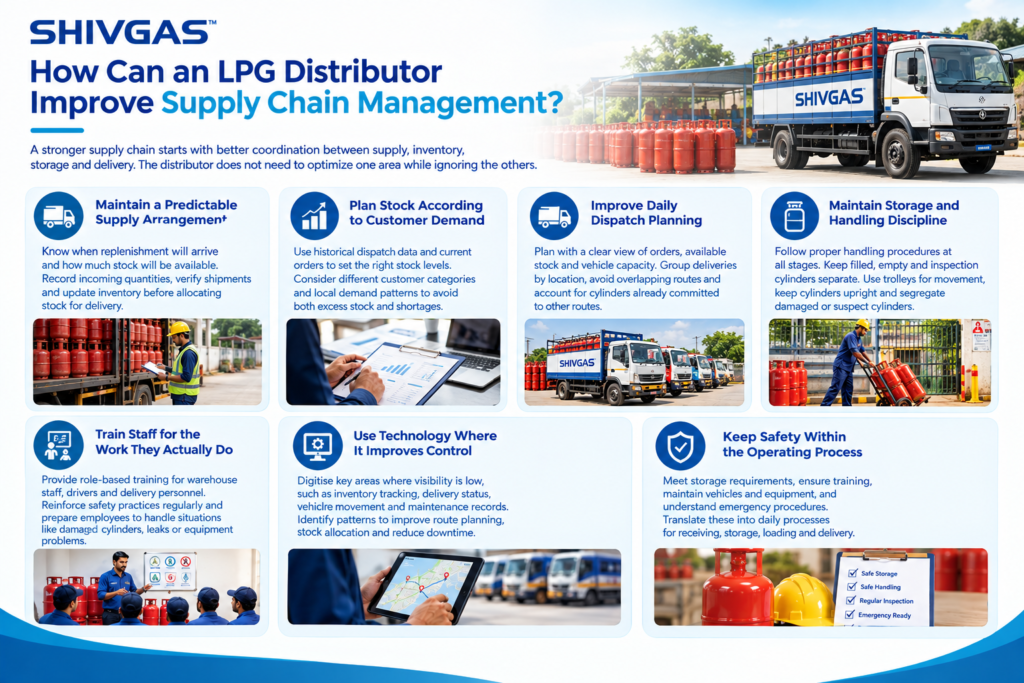
A stable LPG supply depends on knowing when replenishment will arrive and how much stock will be available.
Distributors should understand their supply cycle, lead times and expected demand before setting inventory levels. If replenishment planning begins only after stock becomes low, the business has little room to absorb delays or sudden changes in demand.
Receiving procedures also need attention. The distributor should record incoming quantities, verify the shipment and update inventory records before allocating stock for delivery.
This creates a clear connection between incoming supply and the inventory available for customers.
There is little value in maintaining the same stock level throughout the year if customer demand changes.
Historical dispatch data can show how much LPG customers consume over different periods. The distributor can compare this information with current orders, customer categories and local demand patterns to establish a practical stock requirement.
This becomes more important for an LPG dealership as the customer base expands. Household customers may have different consumption patterns from commercial users, while delivery requirements can also vary across different service areas.
Demand-based planning helps the distributor avoid both unnecessary stock accumulation and avoidable shortages.
Daily dispatch should start with a clear view of orders, available stock and vehicle capacity.
If a vehicle has limited cylinder capacity, the distributor needs to decide which orders can be completed within that route and which should move to another vehicle or delivery cycle. Grouping deliveries by location can reduce unnecessary travel and improve vehicle utilisation.
The dispatch team should also account for cylinders already allocated to other routes. Otherwise, the system may show stock as available even though those cylinders have already been committed.
Small gaps in dispatch planning can become expensive when they occur every day.
Cylinder handling requires clear procedures at every point where employees move stock.
PESO’s safety guidance states that cylinders should not be pushed, dragged or dropped and recommends the use of suitable carts or trolleys for movement. It also advises that cylinders be handled in an upright position unless designed for another position.
Employees should know where filled cylinders, empty cylinders and cylinders requiring inspection belong. Damaged or suspect cylinders should follow a defined process for segregation and further assessment.
The storage area should support this movement instead of forcing employees to work around unnecessary congestion.
Training should correspond to the actual responsibilities of the distribution team.
Warehouse staff need instruction on cylinder movement, storage, loading and unloading. Drivers need appropriate training for vehicle loading and transportation. Delivery personnel need to understand safe cylinder handling and the procedure to follow when they encounter an abnormal condition.
Training also needs periodic reinforcement. Employees who handle cylinders every day can become familiar with the work, but that familiarity should not replace prescribed safety practices.
A practical training programme gives employees a clear response to situations such as damaged cylinders, suspected leaks or equipment problems.
A distributor does not need to digitise every activity to improve the LPG supply chain.
The first priority should be areas where poor visibility creates recurring problems. Inventory tracking, delivery status, vehicle movement and maintenance records are good examples.
Once these records become available, the distributor can identify patterns. Repeated delays on a route may indicate poor route planning. Frequent vehicle downtime may point to a maintenance issue. A change in order volume from a particular area may require a different stock allocation.
Safety should be part of the way the distribution operation is planned.
Storage areas need to meet applicable requirements. Employees need appropriate training. Vehicles and equipment require inspection and maintenance. Emergency procedures need to be understood before an incident occurs.
The distributor’s responsibility is to translate those requirements into everyday procedures that employees can follow during receiving, storage, loading and delivery.
The different stages of LPG distribution depend on each other.
A delay in replenishment affects inventory. An inaccurate inventory record affects dispatch. Poor dispatch planning affects vehicle utilisation. Limited storage space can slow down loading. A vehicle breakdown can push several deliveries into the next cycle.
This becomes more noticeable as an LPG distribution business grows. More customers create more orders, more cylinder movement and greater pressure on the existing storage and transportation infrastructure.
Supply chain management therefore needs to develop alongside the business. Adding customers without assessing storage, fleet capacity and inventory requirements can create operational pressure even when demand is strong.
Distribution data can reveal problems that are difficult to identify from individual transactions.
A distributor can use this information to review practical questions such as:
The answers can guide decisions about stock levels, vehicle allocation, route planning and future infrastructure requirements.
Anyone evaluating an LPG dealership needs to look beyond the expected customer base and sales volume.
Storage infrastructure, location, vehicle requirements, working capital, employee capability and regulatory compliance all affect the operating model. The distributor also needs to understand how much cylinder inventory the facility can handle and how that inventory will move through the delivery cycle.
The same applies when an existing distributor wants to expand. Increasing the customer base may require additional vehicles, storage capacity, staff or digital systems.
A realistic assessment of these requirements can prevent growth from creating avoidable operational constraints.
A reliable LPG supply chain depends on coordination rather than any single intervention. Supply planning, inventory control, storage, transportation and employee training all influence the movement of LPG from the point of replenishment to the customer.
The most practical approach is to identify where the distribution cycle loses time, capacity or control and address those points with better planning and appropriate systems.
When these fundamentals work together, the supply of LPG becomes easier to manage and the distribution operation can handle customer demand with greater operational control.
The main challenges include supply delays, inaccurate inventory records, limited storage capacity, inefficient vehicle utilisation, poor route planning, cylinder handling issues, and gaps in safety compliance.
An LPG distributor can improve efficiency by matching inventory with customer demand, planning delivery routes based on order volume, maintaining vehicles and storage facilities, training employees, and using digital systems for inventory and delivery tracking.
Inventory management helps a distributor maintain adequate stock without occupying unnecessary storage space or tying up working capital. Accurate records also help plan replenishment and prevent avoidable shortages in the supply of LPG.
Distributors need appropriate storage arrangements, safe cylinder handling procedures, suitable transportation practices, employee training, fire protection measures, regular inspections, and compliance with applicable LPG cylinder regulations.
An LPG dealership requires assessment of storage infrastructure, supply arrangements, vehicle requirements, working capital, staffing, customer demand, safety requirements, and applicable regulatory approvals. These factors determine how effectively the business can manage its distribution operations.




Comment (0)