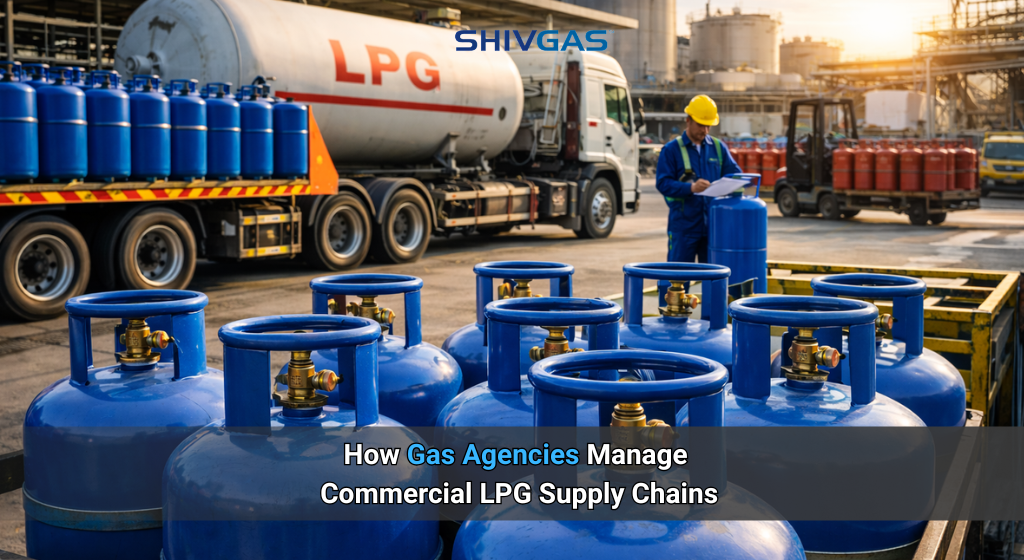
When you run a restaurant, hotel, factory, or commercial kitchen, LPG is not just another utility. It is the fuel that keeps your business running without interruption. One delayed delivery or one unexpected shortage can stop your operations, affect customer service, and increase recurring costs. This is why the role of a gas agency becomes critical in commercial LPG supply.
You depend on your local gas agency to understand your consumption pattern, plan your refills on time, and ensure continuous availability without you having to follow up repeatedly. Commercial LPG demand doesn’t work the same way as household LPG supply. It is larger, more frequent, and less flexible. Gas agencies manage this responsibility by building a structured LPG supply chain that focuses on planning, coordination, safety, and reliability.
The process sits within a much larger LPG supply system. LPG moves from the source through storage and distribution points before reaching the commercial customer. Each stage has its own handling, transport, inventory, and safety requirements.
In this blog, you will understand how LPG agencies manage commercial LPG supply chains in day-to-day operations.
Gas agencies plan commercial LPG demand in a practical and structured way. They do not wait for shortages or urgent calls. Instead, they study usage patterns, prepare stock in advance, and organise supply so that your business continues without disruption.
This forms an important part of the LPG supply model followed for commercial customers. The agency needs to balance the customer’s expected requirement with available stock, delivery capacity, supplier schedules, and transport requirements.
This approach has become even more important as India’s LPG demand has grown steadily in recent years, with commercial and industrial users accounting for around 16% of total LPG consumption in FY25.
Here’s how gas agencies analyse the commercial LPG market:
Gas agencies first understand how much LPG your business uses. They track daily consumption, peak usage hours, and seasonal changes.
For instance, a restaurant may use more LPG during service hours, while a factory may consume LPG based on its production schedule and shifts. A hotel kitchen may see higher demand during weddings, conferences, festivals, or periods of high occupancy.
By studying these patterns, the gas agency knows how frequently you need refills and how much LPG should be available for your operations.
This also helps the agency identify unusual changes in consumption. If your normal requirement suddenly increases, the agency can check whether the change comes from higher business activity, additional equipment, or a change in operating hours.
After understanding your usage, gas agencies plan refills in advance. They schedule deliveries based on your expected consumption instead of waiting for emergency requests.
For a commercial customer, the agency may look at previous orders, average consumption, current cylinder stock, and the expected delivery cycle before planning the next supply.
This planning helps you avoid last-minute pressure and gives the agency enough time to arrange additional LPG if your requirement increases.
The aim is simple: your available stock should match your operating requirement without leaving you dependent on an emergency delivery every time demand rises.
Commercial LPG demand can change without much notice. Events, bulk orders, longer working hours, additional cooking equipment, or seasonal business can increase consumption.
Gas agencies stay prepared for such situations by keeping extra stock ready and maintaining flexible delivery plans. This preparation allows them to respond when demand increases and reduces the chances of a supply interruption.
For businesses that depend heavily on LPG, it also helps to share expected changes with the gas agency in advance. A restaurant preparing for a large event, for example, can inform the agency about the additional requirement instead of placing an urgent order after the existing stock has almost run out.
Once the demand pattern is clear, gas agencies secure LPG supply from their tie-up suppliers. They place orders based on projected requirements and stay in regular contact to coordinate dispatch.
The agency also has to consider supplier lead time and transport schedules before committing to a delivery date. This becomes particularly important when several commercial customers require additional stock at the same time.
This is one of the less visible parts of LPG distribution in India. The customer usually sees only the final delivery, but the agency has to coordinate supply before the cylinder reaches the business premises.
A delay at the supplier or transportation stage can affect the next stages of the LPG supply chain, which is why stock planning and communication matter.
Most private and PSU gas agencies have dedicated, organised storage facilities. They have separate sections for filled and empty cylinders and follow proper stock rotation.
Inventory management is more than counting cylinders. The agency needs to know how much filled stock is available, how many empty cylinders are awaiting collection, what quantity has been allocated for delivery, and how much stock may be required for upcoming orders.
Agencies also keep buffer stock to cater to emergency supply or unexpected demand spikes.
Read More: Is There an Expiry Date for LPG Gas?
Good inventory control also prevents unnecessary delays between cylinder collection, inspection, refilling, storage, and the next delivery cycle.
Gas agencies plan their transportation fleet based on delivery volume, distance, and the type of commercial customers they serve. They allocate vehicles based on their distribution requirements so that regular business deliveries do not get delayed due to domestic distribution schedules.
The transportation stage is an important part of the LPG supply system. Filled cylinders need to move from the storage point to the customer’s premises, while empty cylinders have to return through the distribution network.
Along with vehicle planning, gas agencies train delivery personnel to handle LPG cylinders safely. They train their delivery staff in proper loading and unloading methods, correct cylinder handling, basic safety checks, and emergency response procedures.
So, before you choose a gas agency, see if they have these facilities or not.
Safety remains a top priority in commercial LPG supply. Gas agencies inspect cylinders for leaks, valve condition, and physical damage before dispatch.
Delivery teams follow safety procedures during loading, transport, and unloading. The cylinder also needs a suitable storage and usage location at the customer’s premises.
For commercial users, the agency may provide guidance on cylinder placement, ventilation, regulator checks, and safe handling practices. These checks matter because the LPG supply chain does not end when the cylinder reaches the customer. Safe storage and use at the business premises form the final part of the process.
A commercial customer should also have a clear procedure for reporting a suspected leak, damaged cylinder, or other LPG-related safety issue to the agency.
Gas agencies operate under government regulations issued by authorities such as the Petroleum and Explosives Safety Organisation (PESO) and the Oil Marketing Companies (OMCs) they are authorised by.
These rules define how LPG must be stored, transported, and supplied to commercial users. Gas agencies need the required approvals and licences for applicable storage facilities, vehicles, and cylinder-handling operations.
They also maintain records of their operations. Delivery registers and digital logs can track when cylinders leave the storage facility, when they are delivered, and when empty cylinders return.
These records help the agency track stock movement and support safety inspections, regulatory checks, and internal inventory control.
Many gas agencies now use digital tools to manage daily operations. These systems can track available stock, scheduled deliveries, customer orders, and regular refill cycles.
With this information, agencies can plan supply more accurately and reduce last-minute delivery issues.
Digital booking also gives commercial customers another way to place refill requests. Depending on the agency, customers may be able to use online portals, mobile applications, or system-based booking facilities instead of depending only on phone calls.
This creates a record of the order and gives the agency information about the customer’s requirement before the delivery is arranged.
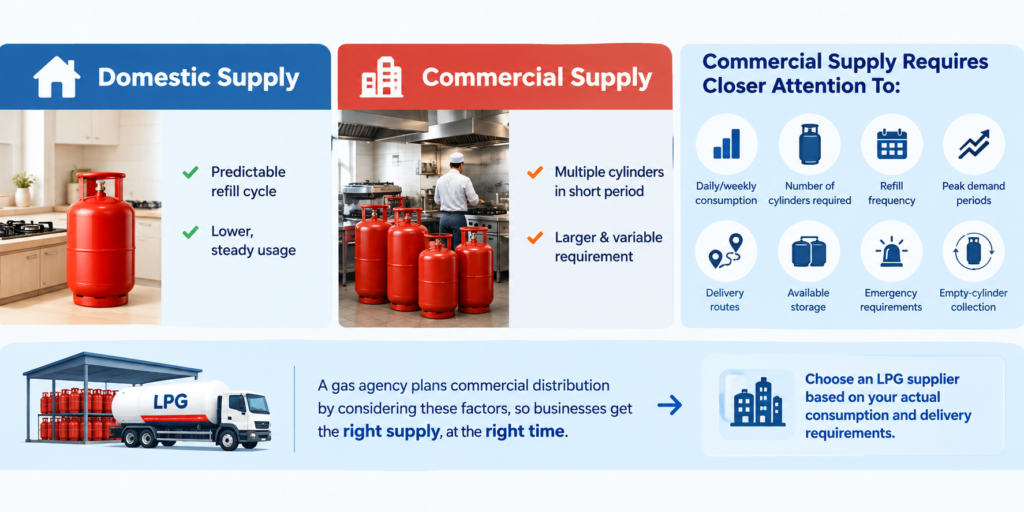
The same basic LPG product can serve both households and businesses, but their distribution requirements can be different.
Household customers generally have a more predictable refill cycle. A commercial kitchen may use several cylinders within the same period, while a factory or food business may have a larger and more variable requirement.
This difference affects the LPG supply model used by the agency.
Commercial supply requires closer attention to:
A gas agency has to account for these factors while planning commercial distribution. That is why a business should choose an LPG supplier based on its actual consumption and delivery requirements instead of treating commercial LPG like a household refill.
LPG connections in India form the customer end of a wider distribution network. For commercial users, the connection and supply arrangement need to match the nature of the business and its LPG requirement.
A restaurant, hotel, food-processing unit, factory, or catering business may have a different consumption pattern and equipment setup. The agency needs to understand the customer’s requirement before deciding how supply should be handled.
The connection is therefore only one part of the arrangement. Storage, regulators, piping where applicable, cylinder capacity, delivery frequency, and safety practices also matter.
For a commercial customer, the important question is not simply whether an LPG connection is available. The question is whether the complete supply arrangement can support the business’s day-to-day requirement.
The LPG supply chain works as a cycle rather than a one-way delivery process.
After a commercial customer uses the LPG, empty cylinders are collected and returned to the distribution point. The agency accounts for these cylinders, checks their condition, and moves them through the next stage of the supply process as applicable.
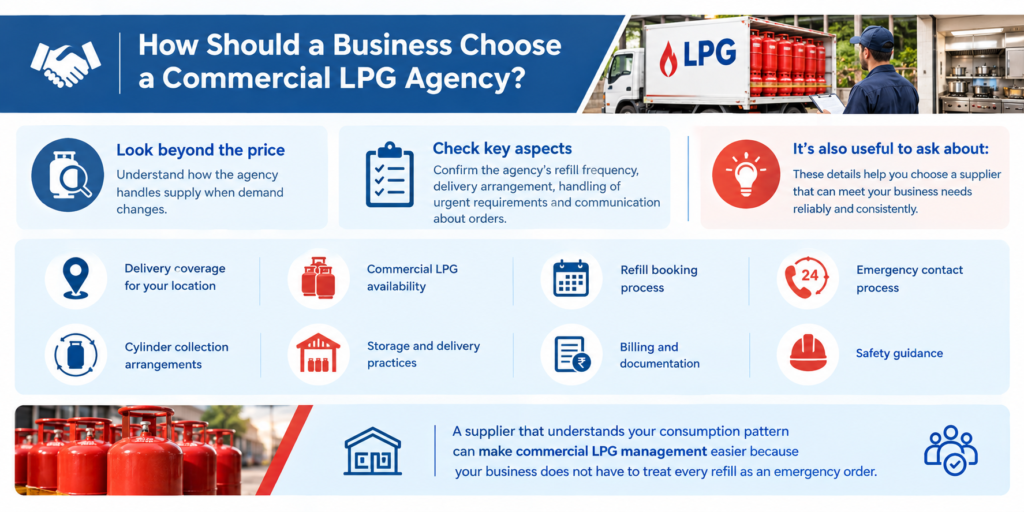
Before choosing a gas agency, look beyond the price of the cylinder. A commercial customer needs to understand how the agency handles supply when demand changes.
Check whether the agency can support your normal refill frequency, whether it has a suitable delivery arrangement, how it handles urgent requirements, and whether it provides clear communication about orders.
It is also useful to ask about:
A supplier that understands your consumption pattern can make commercial LPG management easier because your business does not have to treat every refill as an emergency order.
A commercial LPG supply chain involves much more than moving a cylinder from an agency to a business. Demand planning, supplier coordination, inventory management, transportation, cylinder handling, safety checks, record keeping, and customer communication all form part of the process.
For a restaurant, hotel, factory, or commercial kitchen, a dependable LPG supply system can make day-to-day fuel management easier. The right LPG supply model should match the business’s consumption, delivery frequency, and operating requirements.
When a gas agency manages these parts properly, you don’t have to monitor gas levels constantly or worry about every refill. Your staff can focus on the business while LPG supply remains part of a planned routine.
If your LPG usage increases suddenly, inform your local gas agency as soon as possible. They can check your current stock, arrange additional cylinders or bulk supply where available, and adjust your refill schedule based on your requirement.
For planned events or seasonal demand, informing the agency before the peak period gives them more time to arrange the required supply.
Gas agencies track regular consumption patterns and plan refills based on expected demand. They may also maintain buffer stock for commercial customers and adjust delivery schedules when consumption changes.
However, businesses should not depend entirely on emergency stock. Keeping the agency informed about changes in consumption and maintaining an appropriate working stock at the premises also helps prevent supply problems.
The availability of urgent or same-day delivery depends on the gas agency, location, stock position, delivery capacity, and the customer’s requirement.
Regular commercial customers may have flexible delivery arrangements, but same-day supply should be confirmed with the agency instead of being assumed.
Before dispatch, a gas agency checks cylinders for leaks, valve condition, and visible physical damage. Delivery personnel also follow procedures for loading, transportation, and unloading.
At the customer’s premises, cylinders should be placed in a suitable, well-ventilated location and handled according to the applicable safety requirements.
Commercial customers can use LPG at a much faster rate than many household users. If the agency does not track filled cylinders, empty returns, pending orders, and expected demand, it can become difficult to allocate stock when requirements increase.
Inventory management helps the agency plan the next delivery before the customer’s available stock becomes critical.
Digital systems help agencies maintain records of orders, stock, delivery schedules, and customer requirements. Depending on the agency, commercial customers may also have access to online booking or digital order tracking.
This reduces dependence on manual records and gives both sides a clearer view of the refill process.






Comment (0)