Businesses that use LPG gas every day cannot afford uncertainty. Restaurants, hotels, factories, hospitals, and commercial kitchens depend on a steady gas supply to operate smoothly. For them, LPG gas is as essential as electricity or water. Any delay in supply or sudden price change can disrupt work and increase their monthly or yearly operating costs.
This is where private suppliers come into the picture. Many bulk buyers prefer private gas suppliers because they can offer flexible supply arrangements, delivery schedules, and pricing based on the customer’s requirement. To make the right decision, businesses must clearly understand the gas cylinder price they are being quoted and what that price actually includes.
A quotation may look attractive at first, but the final LPG gas cylinder price can depend on the quantity ordered, cylinder size, delivery distance, contract terms, security deposit, and other applicable charges.
This blog explains how LPG pricing works for bulk buyers, what affects this cost, and how they can secure a fair deal without compromising safety or reliability.
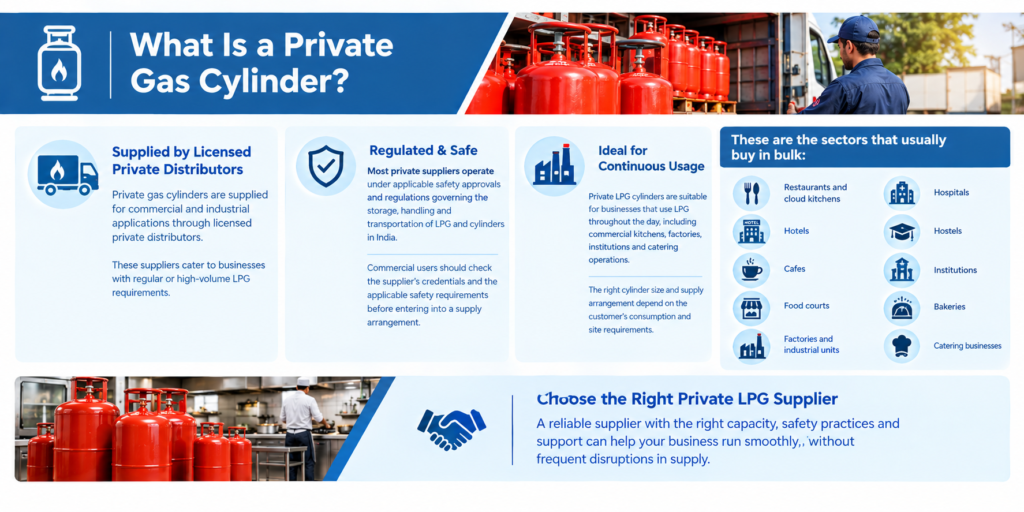
Private gas cylinders are supplied for commercial and industrial applications through licensed private distributors. These suppliers cater to businesses with regular or high-volume LPG requirements.
Most private suppliers operate under applicable safety approvals and regulations governing the storage, handling, and transportation of LPG and cylinders in India. Commercial users should check the supplier’s credentials and the applicable safety requirements before entering into a supply arrangement.
Private LPG cylinders are suitable for businesses that use LPG throughout the day, including commercial kitchens, factories, institutions, and catering operations. The appropriate cylinder size and supply arrangement depend on the customer’s consumption and site requirements.
These are the sectors that usually buy in bulk:
When a business buys LPG cylinders in bulk, the quoted price is only one part of the calculation. The buyer also needs to look at the complete supply arrangement.
A private LPG gas agency may quote different rates to different commercial customers based on order volume, delivery requirements, location, contract period, and other agreed terms. So, there is no single LPG cylinder price that applies to every bulk buyer.
Before accepting a quotation, businesses should check what is included in the rate and what will be charged separately.
Depending on the agreement, the price quoted by a private gas company can include:
The exact inclusions should appear in the quotation or supply agreement. This makes it easier for a business to compare two suppliers without confusing a lower base rate with a lower final cost.
If we analyse the LPG market from a business perspective, a predictable supply cost can make budgeting easier. A small difference in the gas cylinder cost can become a considerable monthly expense when a business consumes dozens or hundreds of cylinders.
For example, a restaurant that uses 100 cylinders a month needs to look at its monthly LPG expenditure rather than the price of one cylinder alone. Delivery charges, emergency orders, and changes in consumption can also affect the final monthly bill.
That is why businesses should calculate the expected monthly cost before selecting a supplier.
Private suppliers may offer different pricing arrangements for commercial users. The quoted rate can depend on consumption volume, delivery frequency, contract duration, cylinder size, location, and service requirements.
A bulk buyer can discuss these factors with the supplier and negotiate terms based on actual usage.
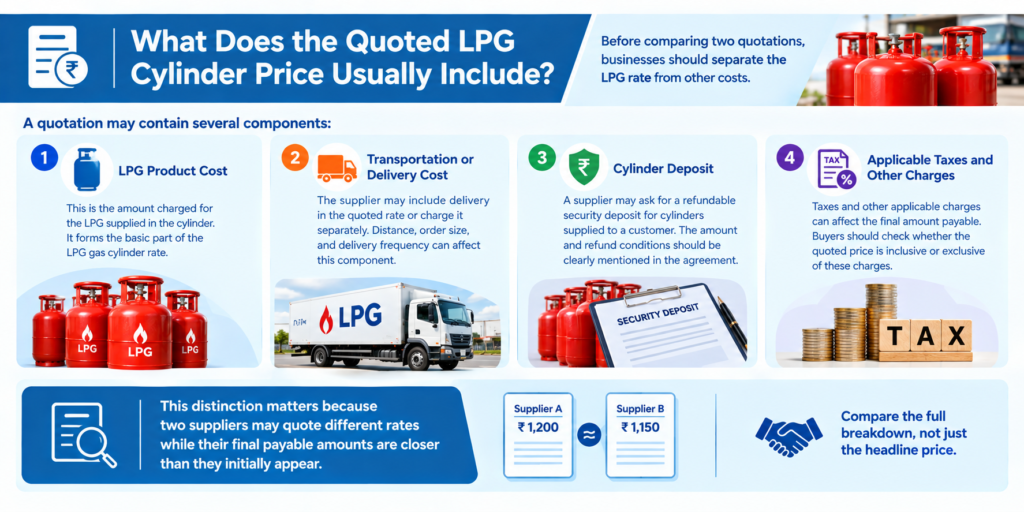
Before comparing two quotations, businesses should separate the LPG rate from other costs.
A quotation may contain several components:
This is the amount charged for the LPG supplied in the cylinder. It forms the basic part of the LPG gas cylinder rate.
The supplier may include delivery in the quoted rate or charge it separately. Distance, order size, and delivery frequency can affect this component.
A supplier may ask for a refundable security deposit for cylinders supplied to a customer. The amount and refund conditions should be clearly mentioned in the agreement.
Taxes and other applicable charges can affect the final amount payable. Buyers should check whether the quoted price is inclusive or exclusive of these charges.
This distinction matters because two suppliers may quote different rates while their final payable amounts are closer than they initially appear.
Several practical factors influence how suppliers determine pricing. If you run a commercial business or work in an industry that needs constant LPG supply, these factors can help you plan better and avoid unexpected costs.
Higher consumption can provide room for volume-based pricing, depending on the supplier’s commercial terms. Suppliers can plan their stock, transportation, and delivery schedules more easily when they have a clear idea of a customer’s regular requirement.
However, bulk buying does not automatically mean that every supplier will offer the same discount. The final rate depends on the agreement between the buyer and supplier.
Most private suppliers may ask for a refundable security deposit for the cylinders they provide. This deposit is separate from the LPG purchase price.
The amount, refund conditions, and responsibility for the cylinders should be clarified before the supply begins. Businesses should also check whether the deposit applies per cylinder or under another arrangement.
Private LPG suppliers may provide safety checks and support as part of their service arrangement. These can include cylinder inspection, handling guidance, and assistance with supply-related issues.
Businesses should understand what safety and maintenance services are actually included instead of assuming that every service comes within the quoted LPG gas cylinder price.
If a business needs LPG outside its planned delivery schedule, the supplier may charge an additional amount for urgent delivery.
These charges can sometimes be avoided through better consumption planning and by keeping an appropriate stock level. A business should also ask the supplier about emergency delivery rates before finalising the agreement.
Cylinder size affects both purchase planning and handling requirements. Larger cylinders can reduce the number of individual refills required, but the correct size depends on the customer’s equipment, consumption, storage arrangement, and applicable safety requirements.
A business should not select a cylinder only because its individual LPG cylinder price appears lower. The cost per unit of LPG, refill frequency, delivery arrangement, and site suitability also matter.
The location of the business can affect transportation costs. A customer located farther from the supplier’s distribution point may have different delivery costs from one located within a regular delivery route.
Contract duration can influence commercial pricing. When a business provides the supplier with a clearer estimate of its LPG requirement over a longer period, the supplier can plan stock and delivery requirements accordingly.
Depending on the agreement, this may allow the buyer to negotiate a more predictable rate or supply arrangement.
However, businesses should check the contract carefully for minimum purchase quantities, price revision clauses, notice periods, deposit conditions, and other obligations before signing.
Yes. A business should not assume that a quoted LPG gas cylinder rate will remain unchanged forever unless the agreement clearly provides for a fixed rate for a specified period.
LPG prices can be affected by changes in input costs, transportation expenses, taxes, supplier pricing, and the terms of the commercial agreement.
This is why a supply contract should explain how price revisions will work. It should also state when the supplier can revise the rate and how the buyer will be informed.
A fair private gas cylinder price is not simply the lowest number on a quotation. Businesses should compare the final payable amount with the supply conditions attached to it.
The right comparison should cover price, delivery, cylinder availability, payment terms, deposit, emergency support, and applicable charges.
The cheapest quoted price may look attractive, but it does not provide the full picture.
A low rate accompanied by high delivery charges or restrictive order conditions may result in a higher monthly expense. Similarly, frequent emergency orders can increase costs if the normal delivery arrangement does not match the business’s consumption pattern.
The better approach is to calculate the estimated monthly LPG expense under each supplier’s terms.
If you approach a private LPG company such as SHIVGAS, ask them for a clear quotation showing the applicable gas cylinder price, delivery charges, deposits, taxes, and other costs.
A written breakdown makes comparison easier and reduces confusion later.
Businesses should also ask whether the quoted LPG gas cylinder price applies to all orders or only to a particular volume or contract period.
Before finalising a supply agreement, businesses should understand how and when the supplier can revise the price.
The agreement should clearly state the basis of price revision, the applicable notice period, and any conditions that can change the final LPG gas cylinder rate.
This information helps businesses plan their LPG budget instead of treating every new invoice as a surprise.
Looking only at the price of one cylinder can give an incomplete picture. A better calculation starts with monthly consumption.
For example:
Monthly LPG cost = Number of cylinders used × LPG price per cylinder
If delivery, taxes, or other charges are billed separately, add those amounts to the monthly calculation.
For a more complete estimate:
Total monthly LPG expenditure = LPG purchase cost + delivery charges + applicable taxes + other agreed charges
Businesses can then compare this figure across suppliers.
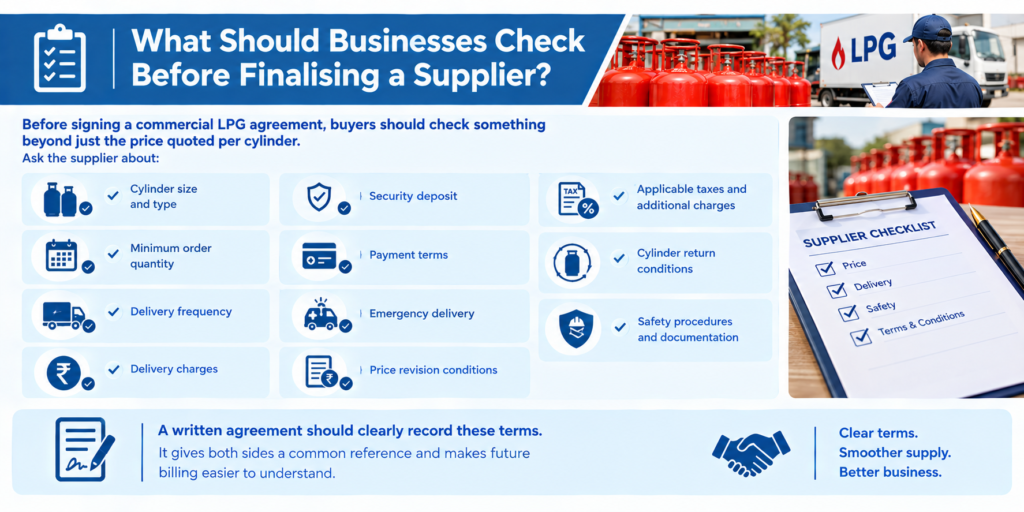
Before signing a commercial LPG agreement, buyers should check something beyond just the price quoted per cylinder.
Ask the supplier about:
A written agreement should clearly record these terms. It gives both sides a common reference and makes future billing easier to understand.
The private gas cylinder price plays a major role in determining how much a business spends on LPG every month. But the number printed on a quotation is only one part of the calculation.
The final gas cylinder cost depends on factors such as LPG consumption, cylinder size, delivery arrangements, business location, contract terms, deposits, taxes, and other applicable charges.
At SHIVGAS, commercial and industrial buyers can discuss their LPG requirements and understand the applicable supply and pricing terms before placing orders.
A proper comparison of the LPG gas cylinder price, delivery cost, contract conditions, and service terms gives buyers a much clearer picture of their real LPG expenditure.
Private LPG suppliers can assess your average monthly consumption and discuss a supply plan based on your requirement. If your usage increases during peak seasons or falls during quieter periods, the number of cylinders ordered can be adjusted according to the agreed supply terms.
If you need additional LPG at short notice, contact your supplier and check the available stock and delivery options. Additional or urgent deliveries may carry different charges depending on the supplier and the arrangement.
Businesses with seasonal or event-based demand can reduce this problem by informing the supplier in advance.
A long-term contract is not necessarily compulsory. However, a longer supply commitment may give a supplier better visibility of your expected LPG requirement.
Whether this results in a different rate depends on the supplier’s commercial terms. Before signing, check the contract for minimum purchase requirements, price revision clauses, and cancellation or notice conditions.
It depends on the terms of the agreement. Some contracts may specify a fixed rate for a particular period, while others may contain a price revision mechanism.
Businesses should read this clause carefully and ask the supplier how future changes will affect the LPG gas cylinder rate.
Do not compare only the price printed against one cylinder.
Compare the complete monthly cost, including:
This gives a more realistic picture of the actual gas cylinder cost for your business.




Comment (0)