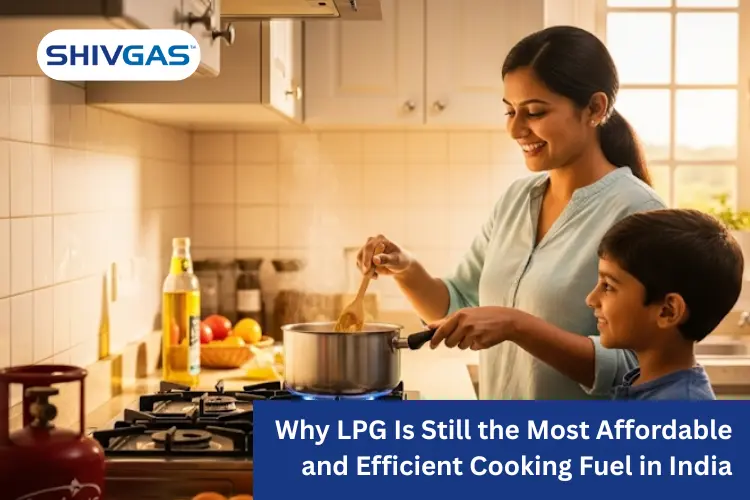
You may not notice it, but the kind of fuel you use for cooking decides how much time, money, and effort you spend in the kitchen. LPG cooking fuel has been powering Indian kitchens for decades now, but do you know why it’s still the preferred choice?
The fuel used in a kitchen affects cooking time, convenience, household expenditure, and indoor air quality. For millions of Indian households, LPG remains the primary choice because it combines a controllable flame with convenient storage and distribution.
But there is a basic question many consumers still ask: which gas is used in a cylinder for cooking?
The answer is LPG, or Liquefied Petroleum Gas. Unlike its name suggests, LPG stays in liquid form inside a pressurised cylinder and turns into vapour when it leaves the cylinder and reaches the burner.
So, which gas is used in cooking gas cylinders, and why has LPG become such a common household fuel?
Understanding its composition, properties, efficiency, and practical use explains why LPG continues to play such an important role in Indian kitchens.
The gas used in kitchen cylinders is LPG, a mixture of light hydrocarbons. Propane and butane form the main components, while smaller quantities of other hydrocarbons can also be present. IndianOil describes LPG as a mixture obtained from crude oil refining or natural gas processing, with propane and butane as its principal constituents.
The LPG inside a cylinder remains mostly in liquid form because the cylinder holds it under pressure. When you open the regulator, the pressure falls and the LPG vaporises. The vapour then travels through the hose and regulator to the stove burner, where it mixes with air and burns to produce heat.
This explains an important point: the cylinder does not simply contain a large volume of gas at normal atmospheric pressure. It stores a much larger quantity of fuel by keeping LPG in a liquefied state.
LPG gas used for cooking provides the heat required for boiling, frying, roasting, simmering, pressure cooking, and other everyday kitchen tasks.
A burner controls the amount of LPG reaching the flame. You can therefore adjust the heat according to the food and cooking method. A low flame suits simmering, while a higher setting provides more heat for boiling or frying.
LPG also has a high energy content by mass, which makes a relatively small quantity of fuel useful for household cooking. Its portability adds another practical advantage because households can store the fuel in cylinders without depending on a fixed pipeline connection.
In simple terms, LPG is classified as an economical cooking fuel and notes its widespread use across urban and semi-urban households, with rural use also expanding.
The answer to why LPG is used for cooking comes down to several practical properties rather than one single advantage.
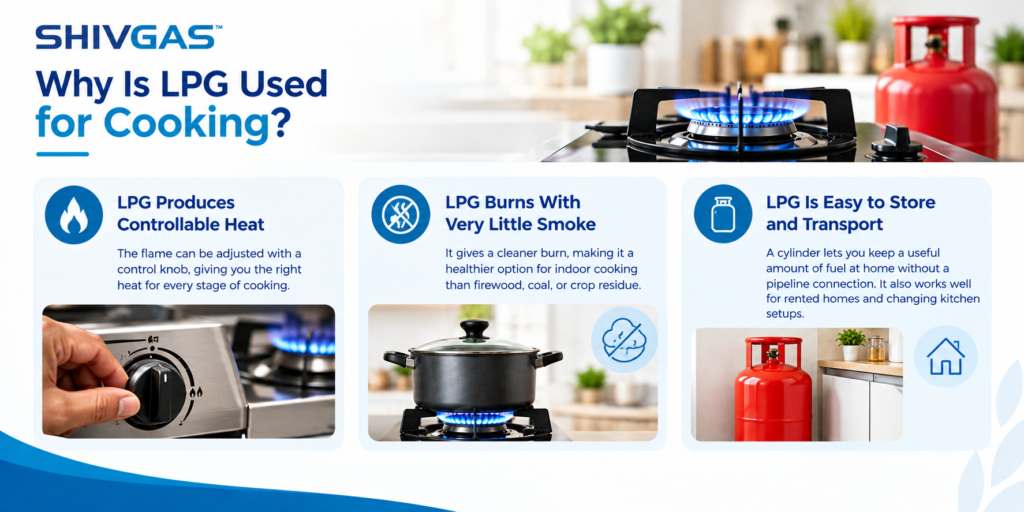
Cooking requires different levels of heat at different stages. LPG burners allow the user to regulate the flame with a control knob, which gives better control than many traditional solid fuels.
This makes LPG suitable for everything from making tea to slow-cooking dal or preparing food that requires sustained low heat.
LPG burns without producing the thick smoke associated with firewood, crop residue, or coal. This makes it a much cleaner option for indoor cooking than traditional solid fuels.
The health advantage formed an important part of India’s transition toward cleaner household cooking. The Pradhan Mantri Ujjwala Yojana was launched in 2016 specifically to expand access to clean cooking fuel such as LPG among rural and deprived households that previously relied on firewood, coal, and cow-dung cakes.
A cylinder allows households to store a useful quantity of cooking fuel without requiring a permanent pipeline connection. This matters in locations where PNG infrastructure does not reach every household.
The same principle also makes LPG practical for rented homes and locations where the kitchen setup may change.
The process is simple.
The LPG in home cylinder remains under pressure in liquid form. When you open the regulator, LPG moves out of the cylinder and enters the gas line. The regulator reduces the pressure to a level suitable for the appliance.
The LPG then reaches the burner, mixes with air and burns. The resulting flame transfers heat to the cooking vessel.
The cylinder, regulator, hose, stove and burner therefore work as one system. Problems with any of these components can affect fuel delivery or safety, which is why proper installation and maintenance matter.
Indian regulations define the regulator as the equipment that controls LPG flow from the cylinder to the gas stove.
Fuel choice depends on more than the price printed on a cylinder. A household also needs to consider availability, equipment requirements, cooking speed, storage and reliability.
LPG performs well across these factors.
A cylinder can supply fuel without depending on electricity availability. It also avoids the need for a fixed natural-gas pipeline. Consumers can replace an empty cylinder with a refill and continue using the same cooking appliance.
The distribution network has also expanded substantially. As of July 21, 2026, more than 105.7 million LPG connections had been released under the Pradhan Mantri Ujjwala Yojana.
That scale illustrates how deeply LPG has become part of India’s household cooking infrastructure.
Calling LPG universally “the cheapest” cooking fuel would be misleading because household costs depend on cylinder prices, consumption, cooking habits, appliance efficiency and applicable government support.
However, LPG can remain cost-effective because it delivers a high amount of usable heat from a compact quantity of fuel. Households can also control consumption by adjusting the flame and avoiding unnecessary fuel loss.
Government support can further reduce the effective cost for eligible consumers. Under the current PMUY framework, eligible beneficiaries receive financial assistance for a new connection, while the scheme also provides benefits related to the first refill and stove.
Therefore, the better way to assess LPG affordability is to look at cost per month and cooking requirement, rather than comparing the price of one cylinder with another fuel in isolation.
Efficient cooking does not require complicated changes. Small habits can reduce unnecessary fuel use.
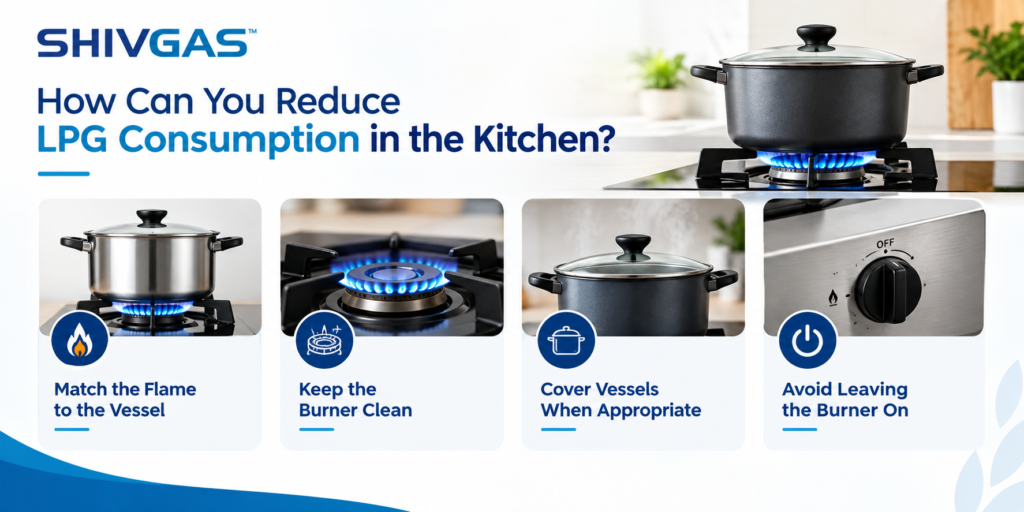
A flame that extends well beyond the base of a vessel wastes heat around the sides. Use a burner size that matches the utensil and keep the flame appropriate for the cooking stage.
Food particles and deposits can interfere with proper gas flow and combustion. A healthy burner should produce a stable blue flame. If the flame changes colour or behaves abnormally, inspect the appliance rather than ignoring the change.
A lid reduces heat loss and can shorten cooking time for many foods. Pressure cookers can also reduce the time required for foods that need prolonged cooking.
Turn the burner off as soon as cooking finishes. If food needs to rest or stay warm, use the appropriate method rather than keeping a high flame running unnecessarily.
LPG is highly flammable, so safe handling matters. The fuel itself has no natural odour; an odorant is added so that users can detect a possible leak. IndianOil notes that LPG is heavier than air and that ethyl mercaptan is added as an odouriser for leak detection.
Keep the cylinder upright in a well-ventilated location and keep it away from unnecessary heat sources. Do not modify the regulator, hose or cylinder connection yourself.
If you smell LPG, do not operate electrical switches or create a flame. Turn off the gas supply if it is safe to do so, ventilate the area and follow the appropriate LPG emergency procedure.
The shift to LPG changed more than the type of fuel used in a kitchen. It reduced dependence on solid fuels that require collection, storage and combustion inside the home.
This change has particular importance in rural households. Before LPG access expanded, many families depended on firewood, coal and other solid fuels. PMUY specifically aimed to replace these traditional fuels with cleaner cooking fuel and reduce their associated health and environmental impacts.
LPG also saves the time required to collect or prepare traditional cooking fuels. That makes the benefit more practical than simply replacing one energy source with another.
LPG remains a practical cooking fuel because it combines energy density, controllable heat, portability and established distribution infrastructure.
However, efficient LPG use depends on the complete cooking system. A good cylinder cannot compensate for a poorly maintained burner, damaged hose, incorrect regulator or wasteful cooking habits.
For households, the sensible approach is simple: use the correct appliance, maintain the connection, store the cylinder properly and monitor how much fuel the kitchen actually consumes.
LPG has remained important in Indian kitchens because it solves several everyday cooking requirements at once. It provides controllable heat, stores compactly in cylinders, works without an electricity supply and reaches households through an established distribution network.
The answer to which gas is used in cooking gas cylinders is therefore easy now: LPG, viz mainly made up of propane and butane. Its physical properties make it suitable for storage, transportation and controlled combustion.
The real benefit comes from using LPG correctly. Safe storage, proper appliance maintenance and sensible cooking practices can help households get more useful cooking from every refill while keeping the kitchen safer.
LPG, or Liquefied Petroleum Gas, is used in domestic cooking cylinders. It mainly contains propane and butane, along with smaller quantities of other hydrocarbons.
Indian household cooking cylinders contain LPG. The fuel remains liquefied under pressure and vaporises when it leaves the cylinder for the cooking appliance.
LPG provides controllable heat, stores efficiently under pressure and works well with household gas stoves. It also produces much less smoke during combustion than traditional solid cooking fuels.
LPG also serves commercial, industrial and other energy applications. Its use extends beyond domestic kitchens because the fuel can provide a portable source of heat and energy.
Yes. LPG is stored predominantly as a liquid under pressure inside the cylinder. It changes into vapour when released through the valve and regulator before reaching the burner.
Use the correct burner size, keep the flame appropriate for the vessel, maintain clean burners, cover utensils where suitable and switch the burner off when cooking finishes. These practices reduce unnecessary heat and fuel loss.



Comment (0)