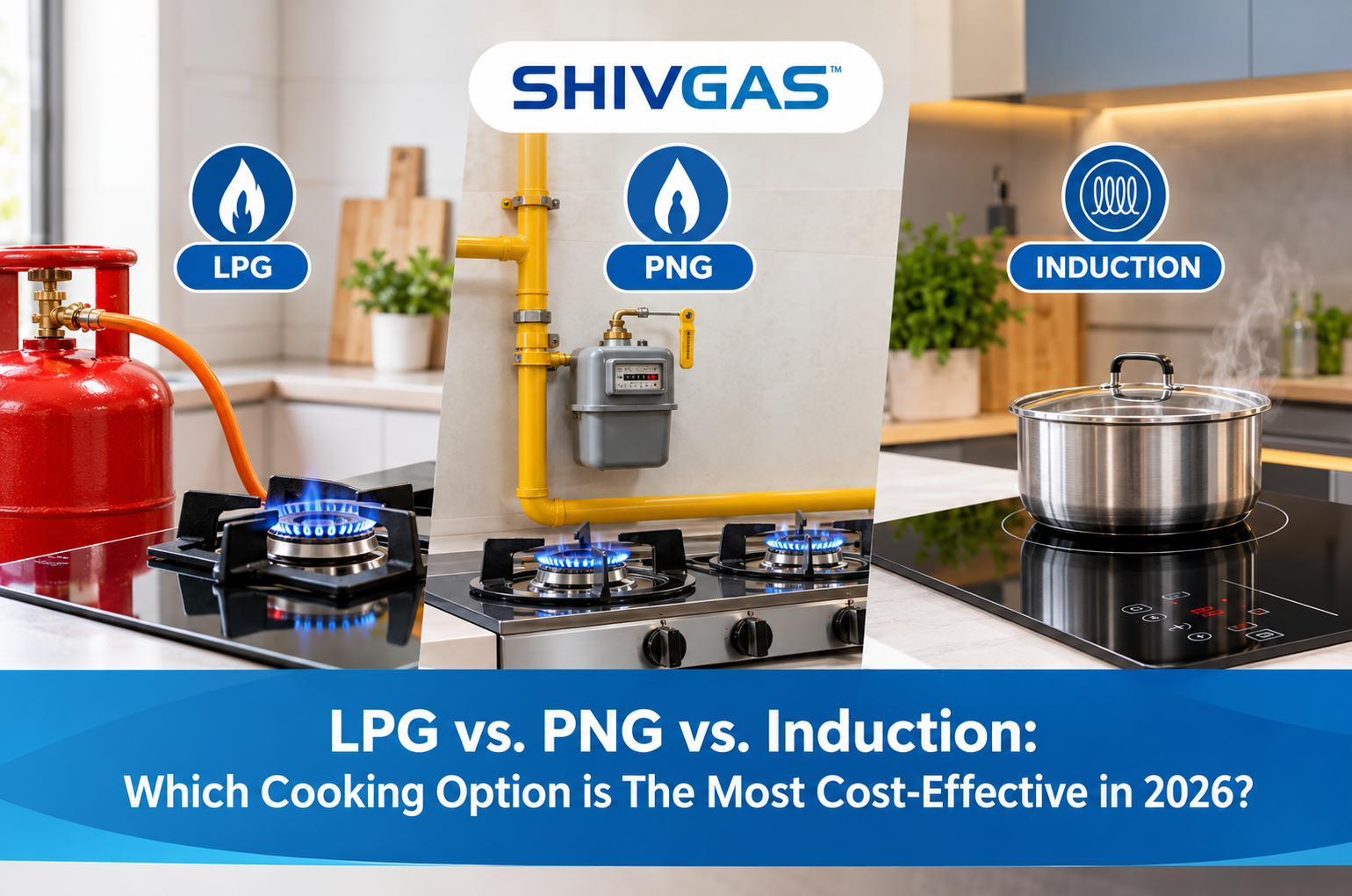
Imagine you are planning your monthly household budget. Your LPG cylinder runs out, the electricity bill keeps changing, and your building may soon offer piped gas. Which option should you choose?
LPG, PNG and induction all cook food, but they work differently and come with different costs. One requires cylinder refills, another supplies gas through a pipeline, and the third uses electricity to heat your cookware.
So, which one is cheaper in 2026? The answer depends on your local fuel prices, cooking habits, electricity tariff and the initial cost of installation or equipment.
In this guide, we will compare the difference between LPG and PNG, explain PNG vs LPG costs, examine the difference between LPG and PNG gas stoves, and see how induction cooking compares with both.
By the end, you will have a clear idea of which option suits your kitchen and budget.
Before comparing costs, let us understand how these three cooking options work.
LPG stands for Liquefied Petroleum Gas. It usually reaches Indian homes in cylinders containing 14.2 kg of gas for domestic use. You pay for a refill when the cylinder runs out.
PNG stands for Piped Natural Gas. A pipeline supplies natural gas to your kitchen, and a meter records your consumption. Instead of booking a cylinder, you pay for the gas you use according to your local provider’s billing terms.
Induction cooking works differently. It uses electricity to heat compatible cookware through an electromagnetic field. You do not need gas to operate the induction cooktop, but your electricity consumption increases.
The main difference between LPG and PNG is the way the fuel reaches your kitchen. The difference between gas cooking and induction cooking lies in how heat reaches the food.
Now, let us compare their costs and practical benefits.
The comparison between PNG vs LPG starts with the price you pay and the amount of fuel your household uses.
With LPG, you pay for a full cylinder. Your actual monthly expense depends on how long that cylinder lasts. A household that finishes a cylinder in 30 days will have a different monthly cost from one that uses the same cylinder for 50 days.
With PNG, the expense depends on the quantity of gas consumed, the local tariff and any applicable fixed or service charges.
The Petroleum and Natural Gas Regulatory Board publishes PNG and CNG price information, while local gas distribution companies provide applicable domestic tariffs. Rates differ across geographical areas.
This means there is no single PNG price or LPG cost that applies to every Indian household.
Suppose your household spends ₹900 on an LPG refill and the cylinder lasts 40 days. Your average fuel expense works out to ₹675 for a 30-day period.
Now compare this with your actual PNG bill for a similar period. Include the gas consumption charge and any applicable recurring charges.
If the PNG expense is lower, it may offer a saving on your current usage. If it is higher, LPG may be the cheaper option for your household.
This is an illustrative calculation, not a statement of current national fuel prices. Use your latest bills to make the comparison.
NOTE: PNG may also involve an initial connection charge or security deposit. Check these costs before switching.
Are LPG and PNG gas stoves the same? Not necessarily.
Both appliances produce a flame, but LPG and PNG have different fuel properties and operating requirements. Their burners need the correct design and settings for the gas supplied.
An LPG stove may require conversion before it can operate on PNG. This work should be handled by an authorised technician using approved components. Do not attempt to change the burner jets or gas settings yourself.
If you are moving into a building with a PNG connection, check whether your existing stove is compatible. The cost of conversion, a new appliance or installation should form part of your budget.
The practical difference between LPG and PNG gas stoves is therefore not just the fuel supply. Appliance compatibility and safe installation also affect the total cost.
Here is where the comparison becomes interesting!
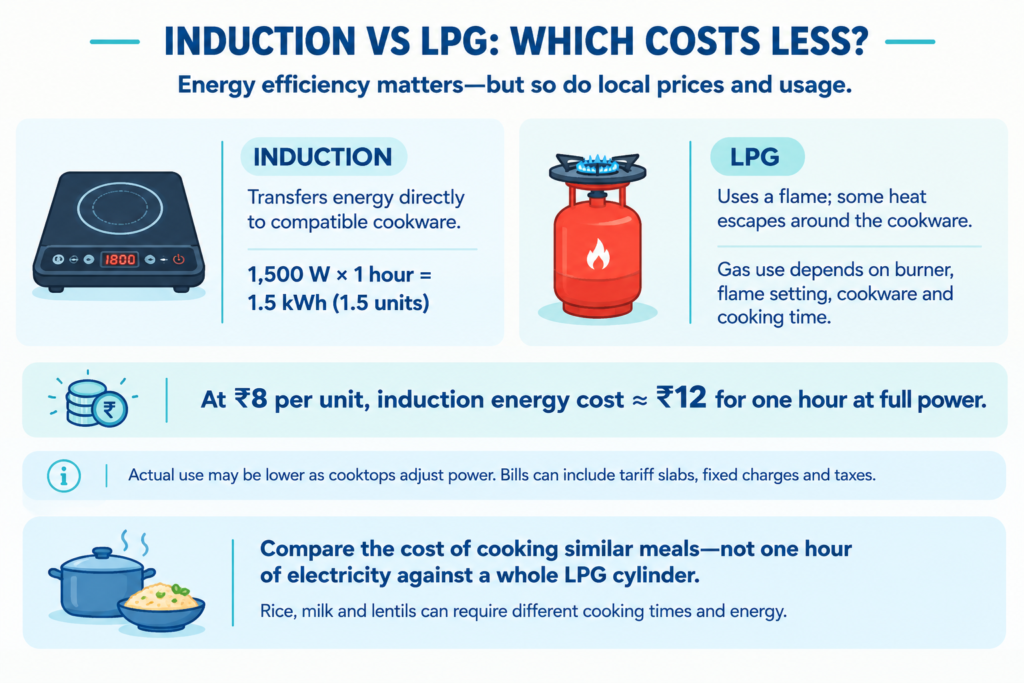
An induction cooktop transfers energy to compatible cookware through an electromagnetic field. Because it heats the cookware rather than relying on a flame to transfer heat, it can use energy efficiently.
LPG cooking uses a flame, and some of the heat escapes around the vessel. The amount of gas used depends on the burner, flame setting, cookware and cooking duration.
However, efficient heat transfer does not automatically mean a lower bill. Electricity and LPG have different prices, and your final expense depends on how much energy each cooking method uses.
Let us calculate the cost of induction cooking.
Suppose you use a 1,500-watt induction cooktop at full power for one hour. It would consume 1.5 kWh, or 1.5 electricity units, if it operated at that power level for the entire hour.
At an illustrative electricity rate of ₹8 per unit, the energy charge would be ₹12 for that hour.
Actual consumption may be lower because induction cooktops adjust power during cooking. Your electricity bill may also include different tariff slabs, fixed charges and applicable taxes.
To compare induction vs LPG fairly, measure the cost of preparing similar meals rather than comparing one hour of electricity with an entire cylinder. The time and energy required to cook rice, boil milk or prepare lentils will vary.
The right option depends on how your household cooks.
LPG may suit households that already have a working stove and prefer cylinder-based supply. It does not require a piped gas connection, although cylinder delivery and refills need planning.
PNG may suit households in areas with an available pipeline. It removes the need to book and replace cylinders and allows you to pay according to metered consumption, subject to the provider’s billing rules.
Induction may suit people who want quick heating, easy cleaning and precise temperature control. It requires compatible cookware and a suitable electricity supply.
For households that prepare several dishes every day, the best choice is the one that provides a reasonable running cost without making cooking inconvenient.
Do not decide on the fuel price alone. Consider the appliance cost, connection expenses, maintenance and availability of supply.
Want to know which option is cheapest for your kitchen? Use the calculator below to estimate your monthly running expenses.
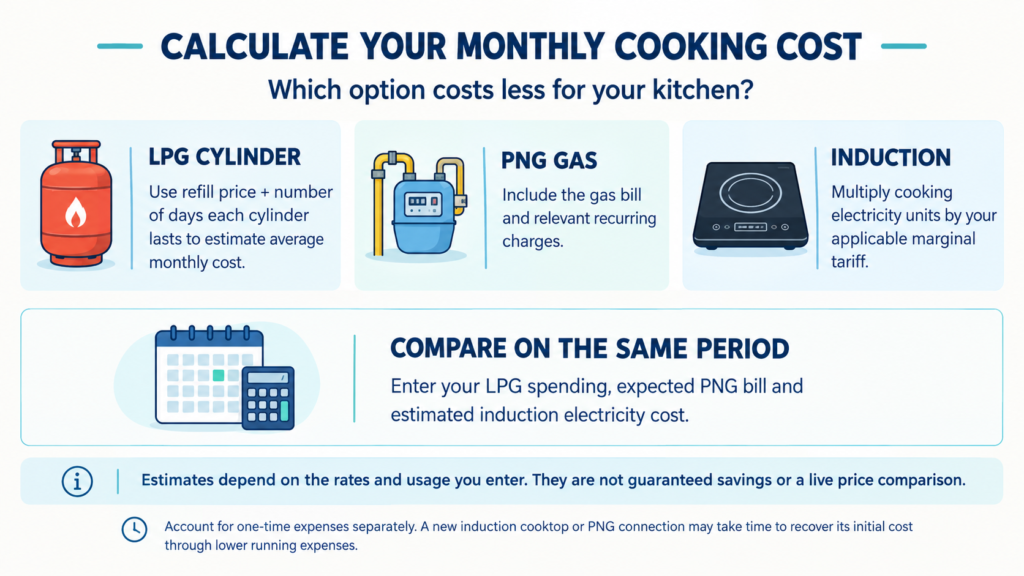
Remember to account for one-time expenses separately. A new induction cooktop or PNG connection may take time to recover its initial cost through lower running expenses.
Fuel prices in India depend on the supply system, local distribution costs and applicable government policies.
In January 2026, the Ministry of Petroleum and Natural Gas explained that domestic LPG pricing and PNG pricing follow different arrangements. It also noted that PNG prices were reduced in select cities following changes in pipeline tariffs.
Electricity prices also vary by state and consumer category. The Ministry of Power explains that State Electricity Regulatory Commissions determine retail tariffs, and state governments may provide subsidies to eligible domestic consumers.
These differences explain why one household may find induction cheaper while another may save money with PNG or LPG.
For an accurate comparison in 2026, check the latest domestic LPG refill price, your local PNG tariff and the electricity rate that applies to your household.
Avoid using another city’s price or a commercial connection’s tariff to estimate your own expenses.
You do not necessarily need to choose just one.
Some households use LPG or PNG for regular cooking and keep an induction cooktop for boiling water, making tea or preparing quick meals. This arrangement can offer flexibility, especially when one cooking method is convenient for a particular task.
However, running two systems also means maintaining two appliances and paying for their energy use. Whether this arrangement saves money depends on how often you use each appliance.
If you already own an induction cooktop, try recording its electricity use for a few weeks. Compare that expense with the LPG or PNG consumption it replaces.
The most cost-effective cooking option in 2026 depends on your local rates, daily cooking needs and initial setup costs.
LPG offers a familiar cylinder-based supply.
PNG removes the need for regular cylinder replacement where a pipeline connection is available.
Induction offers efficient electric cooking, but its running cost depends on your electricity tariff and actual usage.
Before switching, compare your real bills, check appliance compatibility and include installation or purchase costs. That is the clearest way to decide between LPG vs PNG and induction without relying on general claims about which fuel is always cheaper.
LPG is generally supplied to homes in cylinders, while PNG reaches connected homes through a pipeline. Both are used for cooking, but their billing systems, fuel properties and appliance requirements differ.
It depends on your city, local PNG tariff, LPG refill price and household consumption. Compare your actual bills over a similar period to identify the cheaper option.
The burners must suit the gas they use. Some stoves support conversion, but an authorised technician should carry out the work and verify compatibility.
Induction can be cost-effective because it transfers heat efficiently to compatible cookware. However, the final cost depends on the electricity tariff, cooking time, LPG price and appliance efficiency.
Yes. Many households can use both, provided the appliances are installed and operated safely. Compare their combined running costs before deciding whether keeping both makes financial sense.
Check whether PNG is available, compare the local tariffs and consider your cooking habits. If a pipeline connection is unavailable or expensive to install, LPG may be more practical. Induction is another option when electricity supply and compatible cookware meet your needs.



Comment (0)