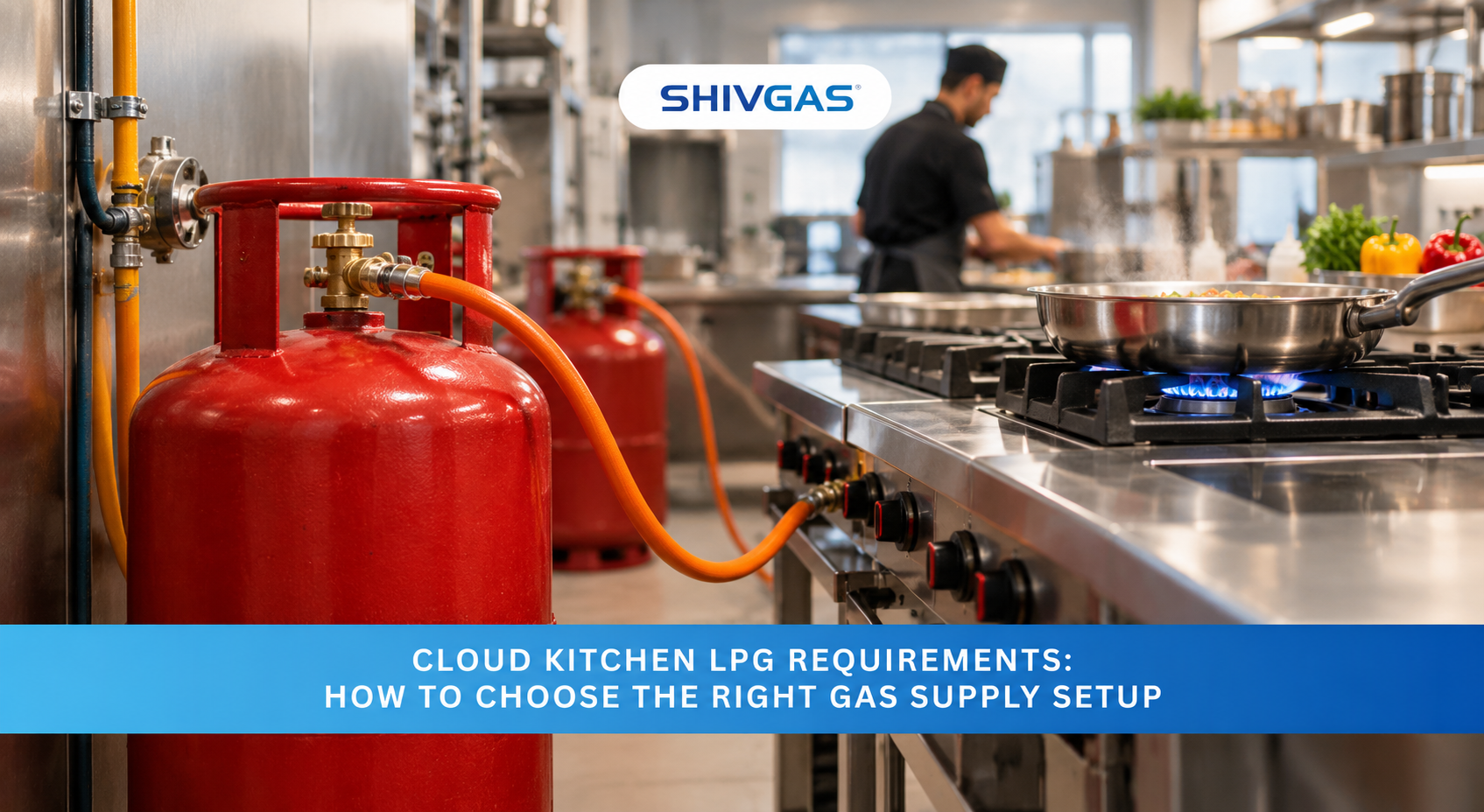
A cloud kitchen may not have a dining area, but it still has the same fuel and safety responsibilities as any commercial kitchen.
If you are setting up a cloud kitchen, your LPG arrangement needs more thought than simply buying a cylinder and connecting it to the stove. You need the right type of connection, suitable cylinder capacity, proper documents, and a storage setup that meets applicable safety requirements.
That is where your cloud kitchen LPG requirements start.
Using a domestic LPG cylinder for commercial cooking may create problems with your distributor and during inspections. A commercial gas connection is the appropriate option for a business that prepares food for sale.
A cloud kitchen may look different from a restaurant, but the cooking process is much the same.
There may be burners, tandoors, fryers, ovens and other equipment running for several hours a day. The only major difference is that customers receive the food through delivery instead of sitting inside the premises.
That difference does not turn a commercial kitchen into a household kitchen.
Domestic LPG is meant for household consumption. Using a domestic cylinder for a business can create issues with the distributor and may also become a problem during inspections.
The lower price of a domestic cylinder can make it look attractive when the kitchen is new and expenses are high. But LPG is a recurring business cost. It is better to plan for the correct commercial connection from the beginning than build the kitchen around a domestic cylinder and deal with the consequences later.
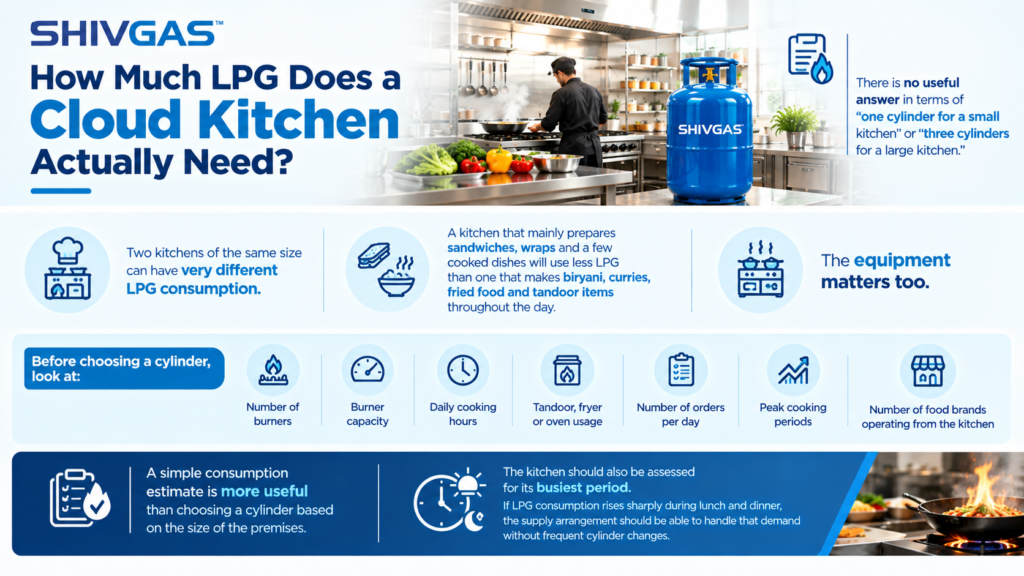
There is no useful answer in terms of “one cylinder for a small kitchen” or “three cylinders for a large kitchen.”
Two kitchens of the same size can have very different LPG consumption.
Consider a kitchen that mainly prepares sandwiches, wraps and a few cooked dishes. Its LPG requirement will be very different from a kitchen that prepares biryani, curries, fried food and tandoor items throughout the day.
The equipment matters too.
Before choosing a cylinder, look at:
A simple consumption estimate is more useful than choosing a cylinder based on the size of the premises.
The kitchen should also be assessed for its busiest period. If LPG consumption rises sharply during lunch and dinner, the supply arrangement should be able to handle that demand without frequent cylinder changes.
Commercial LPG cylinders come in different capacities. The most suitable option depends on how much fuel the kitchen consumes and how much space is available for safe storage.
A 21 kg commercial cylinder may be enough for a smaller cloud kitchen with moderate cooking requirements. A high-volume kitchen may need larger cylinders or several cylinders connected through a suitable arrangement.
One cylinder may work perfectly well during the early days of a cloud kitchen. The situation changes when cooking demand increases.
Multiple cylinders can make sense when several appliances operate at the same time or when the kitchen needs a more reliable supply during long cooking shifts.
However, a manifold is not simply a matter of connecting extra cylinders. The installation has to follow the applicable safety requirements and should be planned with the LPG supplier or qualified installer.
This is where many new kitchens get caught out.
The cooking equipment gets positioned first. Counters, refrigerators and storage racks occupy the available space. Then someone has to figure out where the LPG cylinders will go.
That is the wrong order.
There should also be enough access around the installation for inspection and cylinder replacement.
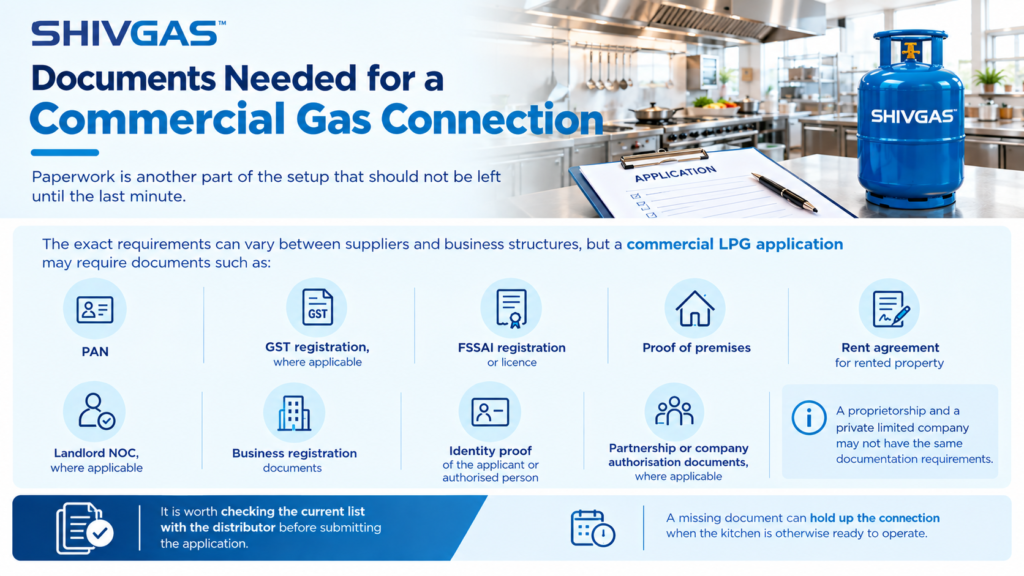
Paperwork is another part of the setup that should not be left until the last minute.
The exact requirements can vary between suppliers and business structures, but a commercial LPG application may require documents such as:
A proprietorship and a private limited company may not have the same documentation requirements.
It is worth checking the current list with the distributor before submitting the application. A missing document can hold up the connection when the kitchen is otherwise ready to operate.
The documentation can change when the cloud kitchen operates through a company rather than an individual proprietorship.
A private limited company may need additional corporate documents, including authorisation for the person applying for the connection. The distributor may also ask for company address and billing information.
If you are replacing or switching from an existing connection, keep previous purchase records or bills available. They may be useful during the application process.
The process has become easier for businesses because several LPG suppliers provide online services.
When applying for a commercial gas connection online, you generally need to provide your business details, premises information, contact details, and the required documents.
After submitting the application, you receive an application or registration number that you can use for further communication.
The process does not end with the online application, though.
An LPG distributor may inspect the premises before approving or releasing the commercial connection.
The inspection can cover the kitchen layout, cylinder storage area, ventilation, and overall safety of the proposed installation.
The location of the cylinders is also considered important. They should remain upright and be kept away from heat sources, open flames, and materials that can catch fire.
The inspection may also consider access and escape routes.
Getting these details right before installation can save time later, especially if the same premises also need to pass a fire safety inspection.
Fire safety deserves special attention in a cloud kitchen because several potential ignition sources operate within a limited space.
Burners, fryers, ovens, electrical equipment, and LPG cylinders can all be present in the same kitchen.
An LPG leak can become dangerous if the gas reaches an ignition source. LPG is heavier than air, so leaked gas can collect at lower levels.
That is why cylinder placement, ventilation, access, and storage conditions matter.
Cylinders should remain upright and at ground level, with adequate separation from heat sources and combustible materials.
LPG is one of the basic things a cloud kitchen needs to get right before it opens. You do not want to think about the gas supply after the kitchen is already handling orders.
Start by working out how much gas your kitchen is likely to use. Look at the number of burners, cooking hours, equipment, and daily order volume. From there, choose the commercial cylinder size and storage setup that makes sense for your operation.
Also, sort out the documents, site requirements, and fire safety approvals before installation. A little planning at this stage can save you from refill problems, layout changes, and compliance issues later.
The right LPG setup does not have to be complicated. It just needs to match your kitchen, follow the rules, and give your team enough gas to get through a busy day without unnecessary interruptions.
A cloud kitchen is a commercial food business, so it should use a commercial gas connection rather than a domestic LPG connection. Using a domestic cylinder for commercial cooking can violate the conditions of domestic LPG use and create regulatory and safety problems.
A 19 kg commercial cylinder can be suitable for a small kitchen with moderate cooking demand. If the kitchen has several burners, fryers, tandoors, or high order volumes, a larger cylinder or multiple-cylinder setup may be more appropriate.
The requirement depends on local fire regulations, the premises, kitchen size, and LPG storage arrangement. Many commercial kitchens require fire safety approval or a Fire NOC. Check with the local fire authority before starting operations.
A private limited company may need corporate authorisation documents, such as a board resolution, along with PAN, GST, premises documents, FSSAI documents, and authorised signatory details. The exact requirements depend on the LPG supplier and business setup.



Comment (0)