You are halfway through cooking dinner when the flame drops without warning. At that moment, you do not know whether the cylinder has thirty minutes of gas left or just a few seconds. Shaking or tapping it does not provide a reliable answer, and this uncertainty is a common issue in most households.
The inability to check LPG cylinder level without a weighing scale affects daily cooking, planning, and refill timing. A standard 14.2 kg domestic cylinder looks almost identical whether it is half full or nearly empty because LPG exists inside as a pressurised liquid. It does not move or create noticeable sound differences like water in a container.
However, the physical properties of LPG—its heat absorption, density, and evaporation behaviour—create measurable signals. These signals can be used to estimate the gas level accurately at home without any special tools.
This guide explains seven practical and reliable methods to check LPG cylinder level without a weighing scale, along with the science behind each method and when to use them.
LPG inside a cylinder exists in two phases: liquid at the bottom and vapour above it. The vapour is what flows to the burner during use. As gas is consumed, the liquid level decreases gradually, and more liquid converts into vapour to maintain pressure.
Because of this phase balance, the internal pressure remains relatively stable across different fill levels. As a result:
The only reliable indicators come from how liquid LPG interacts with heat, sound, and moisture. All the methods below use these principles.
This is the most reliable method to check LPG cylinder level without a weighing scale.
Steps:
Pour warm water evenly from top to bottom of the cylinder. Wait for 30–40 seconds, then run your hand slowly along the surface.
Principle:
Liquid LPG absorbs heat faster than vapour. The portion of the cylinder containing liquid remains cooler, while the upper part returns to normal temperature.
Reading the result:
This method is useful for a fast, everyday check.
Steps:
Tap the cylinder gently from bottom to top using your knuckles.
Principle:
The liquid LPG gas dampens sound, producing a dull tone. Vapour allows resonance, creating a hollow sound.
Reading the result:
This method works well when warm water is not available.
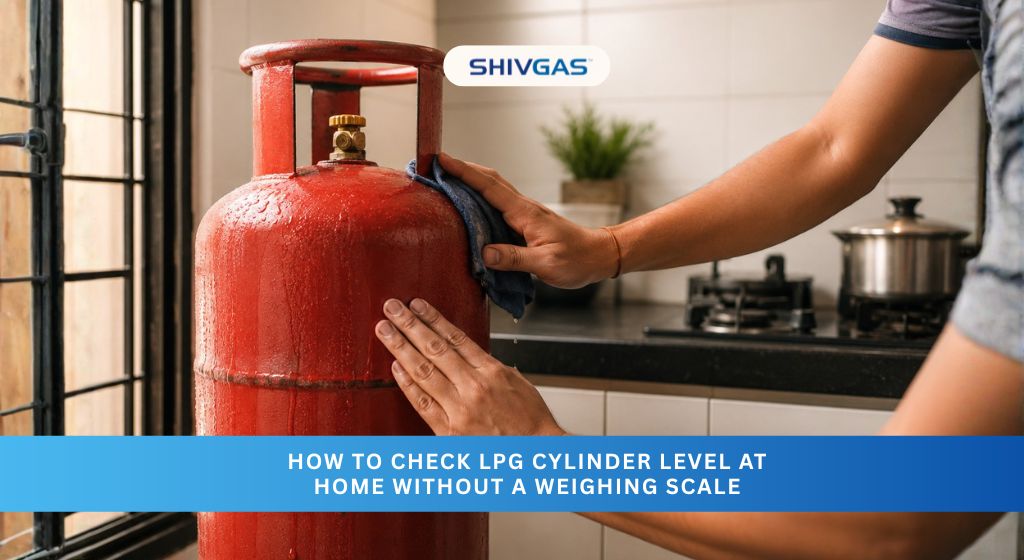
Steps: Wipe the cylinder with a wet cloth from top to bottom and observe after one minute.
Principle:
Water dries faster on warmer surfaces (vapour zone) and slower on cooler surfaces (liquid zone).
Reading the result:
The line between dry and wet areas indicates the exact gas level.
This method gives a general idea based on weight.
Steps:
Disconnect the regulator and gently tilt the cylinder.
Principle:
A full cylinder weighs around 30 kg, while an empty one weighs around 15–17 kg. The difference is noticeable.
Reading the result:
This method works best in warm and humid weather.
Steps:
Pour cold water or observe natural condensation on the cylinder.
Principle:
Cooler areas (liquid zone) attract condensation faster.
Reading the result:
The condensation line indicates the gas level.
This method can be used as a supplementary check, particularly in low-light conditions.
Steps:
Place a bright torch or smartphone flashlight against one side of the cylinder, preferably at the lower section. Allow the light to pass across the surface and carefully observe the opposite side of the cylinder.
Principle:
Liquid LPG gas and vapour LPG gas differ in density and light-scattering behaviour. When strong light passes through the cylinder wall, this difference may create a subtle visual variation at the boundary between the liquid and vapour zones.
Reading the Result:
A faint horizontal shadow or slight variation in surface appearance indicates the approximate level of the liquid LPG inside the cylinder.
Note:
This method is not as reliable as thermal-based methods and should be used only as an additional confirmation alongside other techniques.
This method serves as an early warning indicator to identify when the LPG cylinder is nearing empty.
What to Observe:
Principle:
When the LPG level drops significantly, the rate of vaporisation becomes inconsistent. This leads to fluctuations in gas flow and pressure at the burner, which directly affects flame stability, colour, and performance.
Best Use:
This method should be used as a continuous observation during daily cooking. It helps detect low gas levels early and allows timely refill planning before the cylinder runs out completely.
Checking LPG cylinder level at home without a weighing scale is not difficult when you understand how LPG behaves. The warm water method provides the most accurate result, while the knocking method offers quick daily insights. Other methods act as useful alternatives depending on the situation.
Using two or more methods together improves accuracy and removes uncertainty. With regular observation and practice, checking gas levels becomes a simple and reliable routine instead of a last-minute problem.
You can check the LPG cylinder level at home using simple methods such as the warm water test, knocking method, wet cloth method, or lifting method. Among these, the warm water method is the most accurate, as it clearly shows the difference between the liquid and vapour levels inside the cylinder.
Yes, you can identify if your LPG cylinder is almost empty by observing flame behaviour, checking weight by lifting, or using the knocking method. A weak or unstable flame is a strong indicator that the gas level is very low.
LPG exists in both liquid and vapour form inside the cylinder. The internal pressure remains almost constant regardless of the quantity left, which is why the cylinder does not visibly indicate whether it is full or empty.
It is recommended to check your LPG cylinder level every few days or before starting heavy cooking. Regular checking helps avoid sudden gas shortages during use.
Common signs include a flickering flame, yellow or orange flame colour, reduced flame intensity, and slower cooking time. These indicate that the gas level is critically low and a refill is required soon.




Comment (0)