Every day, millions of Indian families cook meals, brew chai, and heat water using LPG cylinders. It is one of the most reliable and convenient energy sources in our homes. But here is something most of us do not think about: your kitchen is sitting next to a pressurised container of highly flammable gas, and what you store near it matters more than you might realise.
House fires caused by LPG leaks are among the most common domestic accidents in India. The good news? Most of them are entirely preventable. A few simple habits and a little awareness about gas cylinder safety can protect your family, your home, and your neighbours.
Know what to keep away from your gas cylinder — and why it matters.
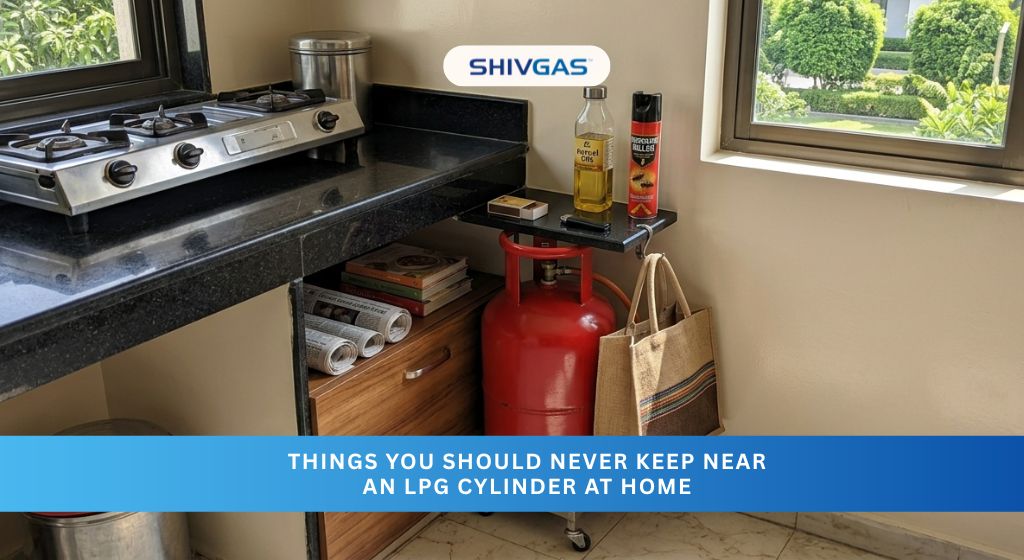
It sounds obvious, but many households keep matchboxes right next to the stove for convenience, often within arm’s reach of the cylinder. A matchbox left too close to a leaking cylinder is a tragedy waiting to happen. Even a small spark is enough to ignite LPG vapour in the air.
LPG is heavier than air, which means leaked gas settles at ground level and spreads quietly. A single strike of a match in such a space can cause an immediate flash fire.
| Safety Tip: Store matchboxes and lighters in a drawer at least 1.5 metres away from the cylinder. After use, always close the matchbox and keep lighters capped. |
In many homes, especially in semi-urban areas, kerosene is used as a backup fuel. Storing it anywhere near the LPG cylinder creates a double-fire hazard. Both LPG and kerosene are flammable, and their combination in a confined space such as a small kitchen can turn a minor leak into an explosive situation.
Petrol and spirit-based cleaning fluids carry the same risk. Their fumes are volatile and can ignite from a spark several metres away.
| Safety Tip: Store all liquid fuels in a separate, ventilated storage area outside the kitchen — never in the same room as the LPG cylinder. |
From hair spray and room fresheners to cockroach killers and paint sprays — aerosol cans are pressurised containers that can explode when exposed to heat. If a gas leak happens and the kitchen warms up even slightly, an aerosol can nearby could rupture and add fuel to the fire.
The propellant inside most aerosol cans is itself flammable, making this combination particularly dangerous in a small kitchen space.
| Safety Tip: Move aerosol sprays to a bathroom cabinet or a cool, separate storage shelf. Never leave them on the kitchen counter near the stove or cylinder. |
Old newspapers stacked next to the stove or under the cylinder are a common sight in Indian kitchens — often used as extra insulation or just left there over time. Paper and cardboard are among the most readily combustible materials and will catch fire easily from even a small spark.
Once paper catches fire near an LPG source, the fire spreads rapidly and becomes extremely difficult to control.
| Safety Tip: Clear out all paper, cardboard, and packaging materials from under and around the cylinder. Designate a separate spot in the house for storing newspapers for recycling. |
Electric sparks from a faulty appliance, a loose socket, or an overloaded extension cord can easily ignite LPG vapour. Many kitchens have a mixer-grinder, electric kettle, or even phone chargers plugged in near the cylinder area.
Even a small electrical arc — completely invisible to the naked eye — is sufficient to ignite a gas-air mixture. Faulty wiring is responsible for many fire incidents that begin near cooking areas.
| Safety Tip: Keep electrical sockets and appliances at a safe distance from the cylinder. Have a licensed electrician check your kitchen wiring annually. Unplug appliances when not in use. |
Plastic melts and burns at relatively low temperatures, releasing toxic fumes. If stored too close to the cylinder or stove, a plastic bag or container can melt onto the cylinder surface, potentially blocking pressure release valves or causing damage to the rubber hose.
Even the heat from a working stove can cause thin polythene bags stored on top of or beside the cylinder to warp or drip.
| Safety Tip: Do not drape polythene bags or plastic items over or around the cylinder. Use steel or glass containers for storing kitchen items near the cooking area. |
Edible oils have a flashpoint — a temperature above which they can catch fire. Placing large oil tins or ghee containers right next to a gas cylinder that radiates heat during cooking increases the risk of oil reaching its ignition temperature, especially if a spillage occurs near an open flame.
A cooking oil fire is one of the fastest-spreading kitchen fires and cannot be extinguished with water.
| Safety Tip: Store bulk cooking oil in a cool pantry cupboard away from the stove. Keep only the immediate-use quantity on the cooking counter. Never leave oil unattended on a hot flame. |
Bleach, acid-based toilet cleaners, drain unblockers, and similar products contain chemicals that can react violently when exposed to heat or when their fumes mix with LPG vapour. Many of these products also have flammable solvents.
Storing them under the kitchen sink near the cylinder, as is common in many homes, can be particularly problematic.
| Safety Tip: Store cleaning chemicals in a separate cabinet away from the kitchen. If you must keep them in the kitchen, ensure they are tightly sealed and stored in a ventilated lower cabinet not adjacent to the cylinder. |
In compact homes, children sometimes play or do homework near the kitchen. Toys left near the cylinder, school bags placed beside the stove, or children playing with the knobs of the cylinder are serious safety hazards.
Young children are naturally curious and may tamper with gas cylinder knobs or regulators without understanding the danger. Toys placed near the cylinder can fall and damage the regulator or hose connection.
| Safety Tip: Establish a clear rule that the kitchen and cylinder area is out of bounds for children while cooking. Keep toys and children’s belongings in a separate room. Fit a child lock on kitchen doors if necessary. |
Light fabrics hanging too close to the flame or the gas cylinder can catch fire instantly. In many Indian kitchens, curtains cover the window above the stove, or a dupatta loosely draped over a nearby chair can billow towards the flame in a gust of air from a fan or open window.
Fabric fires spread incredibly fast and can engulf a kitchen in seconds. This is one of the most underestimated risks in domestic cooking spaces.
| Safety Tip: Use blinds instead of curtains near the cooking area. Ensure no loose or hanging fabric is within one metre of the stove or cylinder. Tie back long clothing before cooking. |
Many households keep a spare cylinder in the kitchen, right next to the active one. While this is common and seemingly harmless, a leak from either cylinder in an enclosed kitchen can cause dangerously high concentrations of LPG in the air — far beyond what a single cylinder would cause.
Two cylinders side by side also means double the risk if a fire does start. Heat from a fire can cause a pressurised cylinder to explode — a phenomenon called a BLEVE (Boiling Liquid Expanding Vapour Explosion).
| Safety Tip: Store the spare cylinder in a well-ventilated space outside the kitchen — a balcony with shade, or a utility area. Connect only the cylinder in active use, and cap the spare securely with its safety cap. |
Many medicines degrade when exposed to heat, and perfumes or nail polish removers (which contain acetone) are highly flammable. Nail polish remover has a very low flashpoint and can ignite near an open flame.
If these items are stored on a shelf above the stove or near the cylinder, they are exposed not just to fire risk but also to degraded efficacy, making them potentially harmful in a different way.
| Safety Tip: Store medicines in a bedroom cabinet or a designated medicine box in a cool, dry place. Keep perfumes and nail products in the dressing table or bathroom — not the kitchen. |
Using your LPG stove in a completely closed room — with all windows shut, no exhaust fan, and no ventilation — is dangerous. Not only does LPG combustion consume oxygen, it also produces carbon monoxide if ventilation is poor. An enclosed space with a gas leak will fill up much faster with combustible vapour.
This is particularly common in winter months when people close all doors and windows while cooking to keep the cold out.
| Safety Tip: Always ensure at least one window or exhaust fan is open when cooking. If you suspect a gas leak, do not switch on any electrical appliances or lights — open doors and windows immediately and step outside. |
Waste materials like dry leaves, wooden crates used for storage, or accumulated food packaging — chip packets, paper cartons, even excess jute bags — can act as excellent fire accelerants. When near a gas cylinder, any of these can take a small spark and turn it into a serious fire within moments.
This risk is particularly common in homes where the kitchen or storage area doubles as a utility space with mixed-use storage.
| Safety Tip: Declutter the area around your cylinder regularly. Keep a dedicated bin in the kitchen and empty it daily. Do not let packaging materials accumulate near the cooking zone. |
Read more:
LPG Safety Tips- Do’s and Don’ts of LPG Cylinder
GENERAL LPG SAFETY TIPS
Simple habits that can save lives
| Check for leaks regularly
Apply soapy water to the regulator and hose joint. Bubbles indicate a gas leak. Never use a flame to check. |
Replace the rubber hose every 2 years
Check for cracks or brittleness. A damaged hose is one of the most common causes of LPG leaks in India. |
| Turn off the regulator when not cooking
This is the single simplest habit that can prevent most accidental leaks in an unattended kitchen. |
Never store the cylinder horizontally
LPG cylinders must always be stored upright. A horizontal cylinder dramatically increases the risk of liquid gas entering the regulator. |
| If you smell gas, act immediately
Do not use switches, phones, or lighters. Open all windows, leave the house, and call your LPG provider’s emergency helpline. |
Keep a fire extinguisher in the kitchen
A small ABC-type fire extinguisher near the kitchen door can make the difference in an emergency. |
| Only use BIS-certified equipment
Always insist on ISI-marked regulators, hoses, and stoves. Cheap or uncertified equipment is a leading cause of LPG accidents in India. |
Ensure good kitchen ventilation
A well-ventilated kitchen disperses any small leaks before they reach dangerous concentrations. Keep the exhaust fan in working order. |
LPG has transformed the way Indian households cook. It is cleaner, faster, and more convenient than most alternatives. But like all energy sources, it demands respect and awareness. The 14 items we have discussed are not rare edge cases — they are things found in millions of Indian kitchens every single day.
The risk is real, but so is the solution: awareness, daily habits, and a little decluttering. A safe kitchen does not require expensive equipment or major renovation. It simply requires that you know what should and should not be near your LPG cylinder.
Share this guide with your family, your parents, your neighbours. In our closely-knit communities, a fire in one home can affect many. Gas cylinder safety is not just personal — it is a responsibility we owe to each other.
And remember: when in doubt, turn it off, ventilate the space, and call the professionals.
Flammable items should be kept at least 1–1.5 metres away from the cylinder and stove to reduce ignition risk.
Immediately open doors and windows, avoid using electrical switches, leave the area, and contact your LPG provider’s emergency service.
No, keeping a spare LPG cylinder in the kitchen increases the risk of gas buildup and fire hazards. It should be stored in a well-ventilated area outside the kitchen.
Avoid storing flammable or hazardous items near an LPG cylinder, such as matchboxes, kerosene, aerosol sprays, paper, plastic, and electrical appliances. These can ignite or worsen a fire in case of a gas leak.




Comment (0)