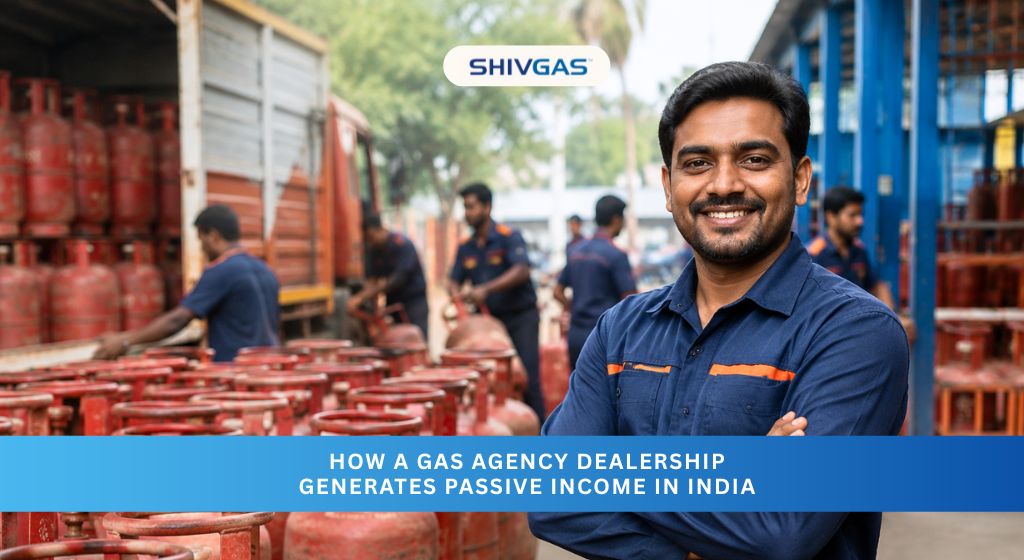
India’s energy consumption pattern has changed rapidly over the last two decades. Urban expansion, rising household income, government-backed LPG penetration programs, and increasing commercial fuel demand have made LPG one of the most stable utility sectors in the country. Unlike trend-driven businesses that fluctuate with consumer behaviour, LPG remains a daily necessity across homes, restaurants, hotels, factories, and institutions.
This is where a gas agency dealership becomes financially attractive. It is not simply a trading business where you sell products once and wait for new customers. Instead, it operates on a recurring demand cycle. Customers continuously refill cylinders, commercial establishments place repeated bulk orders, and the dealership earns through an established distribution ecosystem.
Many entrepreneurs enter the LPG sector because it offers predictable demand, long-term customer retention, and opportunities to create recurring revenue. Over time, once operational systems become stable, a significant portion of dealership income becomes semi-passive. However, this does not mean the business runs without effort. It means your income gradually becomes less dependent on daily customer acquisition and more dependent on repeat consumption.
Understanding how this income model works can help you decide whether investing in an LPG gas dealership is the right long-term business move.
A gas dealership primarily functions as a fuel distribution business. The dealership procures LPG cylinders from suppliers or parent companies and distributes them to residential, commercial, and industrial consumers within an assigned service area.
The core revenue system generally includes:
Unlike many retail sectors where demand changes unpredictably, LPG consumption follows a repetitive usage cycle. A household that uses one cylinder every month is likely to continue doing so for years. Restaurants may require multiple cylinders every week. Hotels, canteens, and factories depend on uninterrupted fuel supply for daily operations.
This repetitive consumption is the foundation of recurring income.
One of the biggest advantages of an LPG gas dealership is that demand is necessity-driven rather than trend-driven.
According to the Petroleum Planning & Analysis Cell (PPAC), India’s LPG consumption has crossed more than 31 million metric tonnes annually, with LPG connections expanding rapidly across both urban and rural households. This sustained growth in consumption highlights why the LPG distribution sector continues to offer long-term business stability for dealership owners.
Consumers may delay purchasing electronics, vehicles, or luxury goods during economic uncertainty. However, cooking fuel remains essential. This creates a relatively stable business environment even during slow market conditions.
Several factors strengthen long-term LPG demand in India:
Residential construction continues to grow across Tier 2 and Tier 3 cities. Every new apartment complex, housing project, or residential community increases LPG dependency.
As population density increases, dealerships gain access to larger recurring customer bases within smaller geographic areas.
Restaurants, cloud kitchens, roadside eateries, cafes, bakeries, and catering businesses rely heavily on LPG for daily operations.
Commercial customers often generate higher monthly revenue compared to residential consumers because their consumption volume is significantly larger.
Over the years, government initiatives encouraging cleaner cooking fuel adoption have expanded LPG accessibility in rural and semi-urban regions.
This has widened the long-term customer market for dealership operators.
A dealership does not become passive immediately after launch. Initially, you need to establish infrastructure, logistics systems, customer acquisition channels, staff management, and operational compliance.
However, once the customer network stabilizes, the business begins generating recurring revenue with lower acquisition effort.
Unlike businesses that constantly chase new customers, LPG dealerships rely heavily on existing users.
A household connected to your distribution system will continue purchasing refills repeatedly. Commercial customers usually place scheduled orders based on operational needs.
This creates a recurring billing structure where income flows continuously from previously acquired customers.
Many dealership operations function within designated service regions. Once customers become associated with your agency, switching patterns are relatively low unless service quality becomes poor.
This territorial customer retention supports stable monthly earnings.
Once you establish delivery routes, staffing structures, and inventory systems, the operational process becomes standardized.
Over time:
If you want to build strong recurring income from a gas agency dealership, commercial customers will eventually become one of the biggest drivers of long-term profitability. Residential consumers provide continuity and customer volume, but commercial clients usually contribute higher monthly revenue and more predictable fuel consumption.
Businesses such as hotels, restaurants, industrial kitchens, hospitals, educational institutions, food manufacturing units, and catering services depend heavily on uninterrupted LPG supply for daily operations. Unlike residential consumers who may refill cylinders once every few weeks, commercial establishments consume LPG continuously throughout the month.
Commercial users typically require larger cylinder volumes and more frequent deliveries. A busy restaurant, for example, may consume multiple cylinders every week to maintain kitchen operations during peak business hours. Similarly, hospitals and institutional kitchens cannot afford fuel shortages because food preparation is part of essential operations.
This creates a strong recurring demand cycle for your dealership.
In many cases, a single commercial customer can generate revenue equivalent to several residential consumers combined. This improves operational efficiency because managing a few high-volume clients is often more profitable than handling hundreds of low-volume orders individually.
The profitability of an LPG gas dealership is closely connected to operational efficiency. Strong market demand alone is not enough. If your delivery systems, storage facilities, and operational processes are poorly managed, profitability can decline through delays, leakage risks, inventory problems, and customer dissatisfaction.
A professionally managed dealership treats infrastructure as a long-term operational investment rather than a short-term expense. They support future business growth by investing in:
A gas agency dealership generates recurring income because LPG is a daily necessity with continuous consumption cycles. Residential refills, commercial fuel demand, and long-term customer retention create a stable business environment that few industries consistently maintain.
However, sustainable income does not come automatically. Your profitability depends on infrastructure quality, operational discipline, customer service, safety compliance, and delivery efficiency.
If you approach the business strategically, invest in proper systems, and build a strong local distribution network, an LPG gas dealership can gradually evolve into a dependable long-term income-generating asset in India.
Yes, a gas agency dealership can be profitable because LPG is an essential utility product with continuous demand from households, restaurants, hotels, and institutions. Profitability usually depends on customer volume, operational efficiency, delivery management, and commercial client acquisition.
An LPG gas dealership generates recurring income through regular cylinder refills and long-term customer retention. Residential consumers require periodic refills, while commercial establishments often place frequent bulk orders, creating stable monthly revenue opportunities.
Yes, commercial clients often contribute significantly to dealership revenue. Businesses such as restaurants, hospitals, caterers, and hotels consume LPG in larger quantities and require uninterrupted supply, which creates higher order frequency and predictable demand cycles.
The major challenges include high initial investment, strict safety compliance, logistics management, inventory control, and timely delivery operations. Managing commercial supply commitments and maintaining customer trust also play an important role in long-term business stability.
A gas agency dealership cannot become completely passive, but it can gradually become semi-passive once strong operational systems are established. Trained staff, automated billing, organized delivery management, and stable customer retention can reduce the owner’s daily operational involvement over time.



Comment (0)