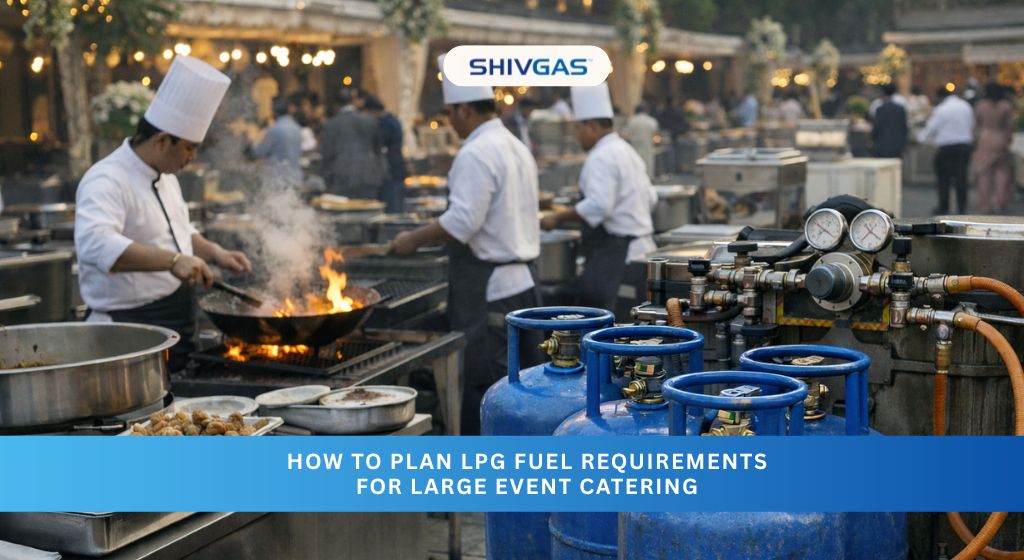
Large event catering is very different from cooking in a normal kitchen. When you are handling 800 guests at a wedding or 1,500 people at a corporate event, things move fast and expectations are high. You can’t tell guests to wait because the kitchen is not ready. Food has to be served hot. Counters have to stay active always. In all of this, LPG is what keeps your cooking going.
Think about what usually happens on an event day. Guests walk in and admire the decoration. They look at the buffet setup and the live counters. Everything appears organised. But behind that setup, you are managing multiple burners at the same time. Big vessels are on flame for hours. Starters are being fried in batches. Gravies are reheated again and again so they stay hot until the last guest is served.
Now imagine if the gas runs low in the middle of this rush. Even a short interruption can slow everything down. One counter stops. Then another. Service begins to lag. Guests start waiting. That is stress you do not want on event day.
This is why fuel planning cannot be done at the last moment. You have to think ahead. Start with how many guests are expected. Then look at your menu. How many live counters will run? How long will the burners stay on? Once you have clarity on this, you can speak to your nearby private gas agencies and discuss how many commercial cylinders you will actually need, including one as a backup.
In the next sections, you will see how to calculate LPG requirements that match what really happens in such situations.
When you think about your event’s success, you usually think about food taste and presentation. But a constant fuel supply is what supports both.
If LPG runs out:
Guests may not know the reason, but they will remember the delay.
Proper planning gives you control. When you coordinate in advance with reputed private gas companies, you reduce this uncertainty. You know how many cylinders are coming. You know when they will arrive. You know you have backup.
Fuel planning also helps you manage costs. When you estimate properly, you avoid over-ordering or emergency purchases at higher rates.
Most importantly, it protects your reputation. In catering, one bad event can affect future bookings.
Now let us move step by step how the entire planning process is to be done.
Before anything else, confirm your final guest number. Do not work with rough estimates.
If you are cooking for 300 people, your fuel use will be controlled. But once you cross 700 or 1,000 guests, the scale changes completely. You use bigger vessels. Cooking time increases. Reheating continues for longer.
More guests mean you will need more number cylinders to run a continuous flame throughout the event.
When you talk to a private gas agency, the first question they ask is about guest count. That number gives them a base to guide you.
Next, sit with your kitchen team and go through the complete menu.
Some dishes require constant flame. Others need minimal heating.
High fuel usage items usually include:
If you are running four or five live counters, LPG consumption will be high.
On the other hand, desserts prepared in advance or cold dishes do not add much to on-site fuel use.
Before confirming cylinders, check your menu and create an estimate of the probable fuel consumption. This step avoids under-ordering.
Now move to the kitchen setup.
How many burners will run at the same time?
In large events, it is common to have 6 to 10 commercial burners working together during peak hours. Each commercial burner can use around 1 kilogram of LPG per hour, depending on flame level.
So if:
That alone can use around 40 kilograms of LPG.
And this does not include reheating during service.
Instead of calculating based on total event duration, focus on peak cooking time. That is when maximum gas is consumed.
When you explain burner count and cooking duration clearly to private gas agencies, they can guide you better.
Large catering events require 21 kg commercial cylinders. Domestic cylinders are not suitable for such use.
Commercial cylinders:
Most caterers search for ‘Private Gas Agency Near Me’ so that delivery is on-time and emergency replacement can be made quick.
If the venue is in a remote area or crowded city location, local supply support becomes even more important
NOTE: A Simple Calculation To Know Your LPG Requirement for Large Event Catering
Let us take a simple example.
Event: Wedding
Guests: 1,000
Burners: 9
Peak cooking hours: 5 hours
If each burner uses around 1 kilogram LPG per hour:
9 × 1 × 5 = 45 kilograms
Add around 20 kilograms for reheating and extended service.
Total estimated LPG use = 65 kilograms (approx.)
Since one commercial cylinder holds around 21 kilograms, you need at least 3 cylinders. With backup planning, keeping 5 cylinders would be a safer option.
This is something you should never ignore.
Even if your calculation shows that you will need 5 LPG cylinders for cooking, do not take only 5. Order a few extra.
Event days rarely go exactly as planned. Sometimes more guests arrive than expected. Sometimes cooking takes longer. Sometimes the client asks to add one more dish at the last minute. All of this increases gas use.
That is why, at SHIVGAS, we suggest keeping 20 to 30 percent extra cylinders as backup.
This extra stock gives you peace of mind. If one cylinder finishes earlier than expected, you can replace it immediately without stopping the counter.
You can always return unused cylinders later than to struggle with a gas shortage in the middle of service.
Do not wait until the morning of the event to arrange your LPG.
During wedding season or festivals, Private Gas Companies handle many large bookings. If you delay confirmation, you may face availability issues or late delivery.
It is better to confirm your requirement at least a few days before the event. This gives both you and the supplier enough time to plan properly.
Also, visit the venue in advance and check a few practical things:
When you work with a reliable Private Gas Agency Near Me, coordination becomes easier. Local suppliers usually understand the area well and can manage delivery smoothly, even in busy or semi-urban locations.
Planning the right quantity of gas is important, but using it safely is equally important.
Always keep cylinders in an upright position. Place them in an open or well-ventilated area. Do not keep them too close to direct heat or open flames.
Before you start cooking, check the hoses and regulators properly. Make sure there are no cracks or loose connections. Test for gas leaks before turning on the burners.
During the event, assign one responsible team member to keep an eye on the LPG setup. If there is any issue, it can be handled quickly before it becomes serious.
Reliable private gas agencies will also explain to you the basic safety steps. Follow their guidance and do not take shortcuts.
Read More: LPG Gas Safety Guidelines for Catering Businesses
In large catering events, problems usually begin where planning is weak. LPG is not something you should think about only when a cylinder becomes empty. It is a core part of your event setup, just like your kitchen equipment and staff.
When you consider fuel management as a serious responsibility, you reduce pressure on event day. You avoid sudden interruptions. You keep your team calm and focused. That confidence reflects in your service.
And, when you partner with a reliable private gas company, it adds another layer of assurance for your event.
In the catering industry, LPG is the most commonly used fuel. It gives a strong and steady flame, which is important for cooking large quantities of food.
Gas usage depends on the type of burner and flame level. In large catering setups, a commercial burner can use around 0.8 to 1 kilogram of LPG per hour when running at high flame. If multiple burners operate together, total gas consumption increases accordingly.
To calculate LPG consumption, multiply the number of burners by the average gas used per hour and then by the total cooking hours. For example, if 5 burners use 1 kilogram per hour for 4 hours, total usage will be 20 kilograms. Add extra for reheating and backup planning.



Comment (0)