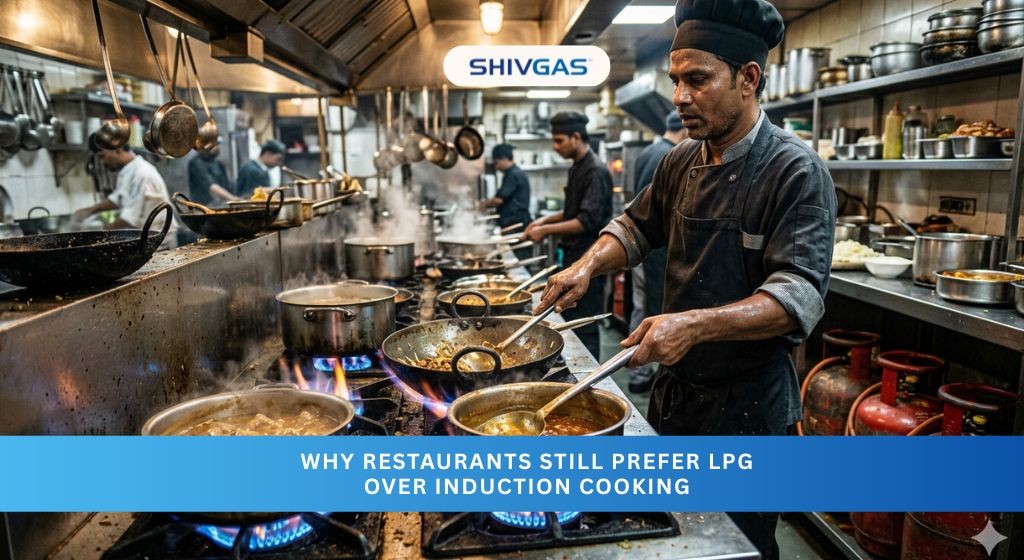
If you run a restaurant or manage a commercial kitchen, you have probably been told at some point to consider switching to induction cooking. It is pitched as cleaner, safer, and more energy-efficient. And honestly, some of those claims are not wrong. But here is what that pitch often leaves out: induction does not work the way a real kitchen works.
LPG gas has been powering commercial kitchens for decades, and in 2026, it still dominates. Not because restaurant owners are resistant to change, but because they have tried both options and made an informed decision.
This blog breaks down exactly why LPG gas cylinders continue to be the preferred fuel source for restaurants, cloud kitchens, and large-scale catering operations across India.
A home kitchen and a commercial kitchen are two completely different environments. At home, you cook one dish at a time. In a restaurant, five burners are running simultaneously, orders are coming in every few minutes, and the kitchen team has no margin for delay.
In this kind of environment, fuel choice is not just a preference. It is an operational decision.
LPG gas delivers instant, high-intensity heat. You turn the knob, the flame appears, and the cooking begins. There is no warm-up time, no surface restriction, and no dependency on power supply. For a kitchen that runs 12 to 16 hours a day, that kind of reliability matters more than almost anything else.
LPG is considered to be the most reliable option when we consider it as a fuel for cooking. Here are a few areas where LPG fails the modern induction cooking technology.
Induction cooking depends entirely on a stable power supply, which is not always guaranteed in real working conditions. In a commercial kitchen, even a short disruption can create immediate problems. If the power drops while multiple dishes are being prepared, cooking stops instantly. Half-cooked gravies, unfinished orders, and delayed service become unavoidable.
LPG gas removes this dependency. The flame remains consistent regardless of external power conditions. For example, during peak dinner hours, when several burners are in use at the same time, LPG allows uninterrupted cooking.
Induction cooking requires specific types of cookware, which creates limitations in a commercial setup. Most restaurants use a wide range of utensils—large aluminium vessels for bulk cooking, iron kadais for frying, and deep pots for gravies. These are chosen based on cooking needs, not compatibility with a specific technology.
Switching to induction often means replacing or modifying existing cookware, which adds cost and disrupts workflow. LPG gas does not impose any such restrictions. Chefs can use any vessel directly on the flame without thinking about compatibility. This flexibility becomes especially important during busy hours when quick decisions and fast transitions between dishes are required.
In a busy kitchen, chefs adjust heat based on what they see and feel, not by checking settings.
With LPG gas, the flame is visible. If the food is cooking too fast, you reduce the flame. If it needs more heat, you increase it.
Now compare that with induction. There’s no flame, just numbers or buttons. You have to press, wait, and then check if it’s right. That extra step might not seem like a big deal, but when you’re handling multiple orders at once, it breaks your flow.
For example, while tossing noodles or frying something quickly, you often need to change heat within seconds. With LPG, that happens naturally.
Setting up an induction-based kitchen involves more than just purchasing new equipment. Commercial induction units are expensive, and they often require additional infrastructure to function properly. Electrical systems may need upgrades to handle higher loads, and compatible cookware must be purchased separately.
For example, a restaurant planning to run multiple induction units simultaneously may need to invest in upgraded wiring and higher-capacity connections. These additional costs increase the overall investment significantly.
In comparison, LPG setups are simpler and more cost-effective to install. Burners, pipelines, and LPG gas cylinders are widely available and do not require major infrastructure changes, making them a more practical choice for many restaurant owners.
In most restaurants, there are certain hours when the kitchen is under constant pressure. Orders keep coming, all burners are in use, and there’s no time to slow down.
LPG handles this situation well. Even when multiple burners are running together for long hours, the heat stays consistent. Chefs can cook different dishes at the same time without worrying about performance dropping.
For example, one burner might be used for frying, another for gravy, and another for boiling—all at once. LPG supports this kind of parallel cooking without any issue.
With induction, everything depends on how much load the electrical system can handle. When several units run together, especially for long hours, it can affect performance if the setup is not strong enough.
As a restaurant grows, the kitchen needs more cooking capacity to handle additional orders.
With LPG, this is easy to manage. You can simply add more burners or keep extra LPG gas cylinders as backup. There is no need for major changes, and the existing setup continues to work without disruption.
For example, during festive seasons or sudden increases in demand, a kitchen can quickly scale up by adding a few more burners and cylinders. This can be done without stopping daily operations.
With induction, expansion is not as straightforward. Adding more units often requires checking whether the electrical system can handle the extra load. In many cases, wiring upgrades or higher-capacity connections are needed, which takes time and increases costs.
Induction can work in certain setups, especially where the volume is low and everything is controlled. But most commercial kitchens don’t operate like that. They run for long hours, get busy without warning, and need things to keep moving without interruptions.
In that kind of situation, LPG just makes life easier. You turn it on, adjust the flame, and keep cooking. No extra steps, no waiting, no dependency on power.
That’s why most restaurants still go with LPG gas cylinders. Not because they haven’t explored other options, but because this is what works when the kitchen is under pressure.
At the end of the day, it’s simple. When orders are coming in and the kitchen is busy, you rely on what helps you keep up. And for most kitchens, that’s still LPG.
Restaurants stick with LPG because it works without interruption. It gives instant heat, does not rely on electricity, and keeps the kitchen running smoothly during busy hours.
In most cases, no. Induction setups involve higher upfront costs, electrical upgrades, and compatible cookware. LPG is easier to set up and more practical from a cost point of view.
It depends on the electrical setup. If the system is not strong enough, performance can drop when multiple units run together. LPG handles continuous heavy cooking more reliably.
Chefs prefer LPG because they can see the flame and adjust heat instantly. This makes it easier to manage cooking, especially when handling multiple dishes at the same time.
No, it usually is not. Switching requires new equipment, changes in wiring, and adjustments in the kitchen setup, which increases both time and cost.



Comment (0)