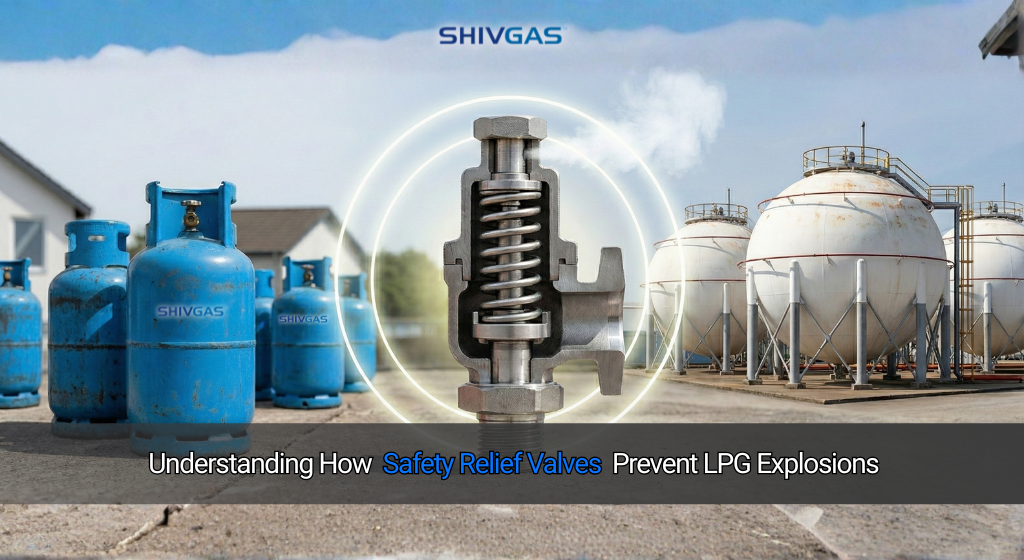
Every year, several LPG-related accidents make headlines and most of them are caused by leaks, faulty equipment, or pressure build-up in cylinders. These incidents could often be prevented with one simple component: safety relief valves.
LPG is stored under high pressure, be it in a cylinder kept in the home kitchen or the storage tank at a gas agency. If that pressure rises beyond the safe limit may be due to heat, overfilling, or system failure, it can cause an explosion. A safety relief valve is designed to prevent that. It automatically releases excess gas pressure before it reaches an explosive level.
For gas agencies, this device is not optional, it’s a regulatory and operational necessity. And for consumers, understanding how these valves work makes sure that their kitchen LPG cylinder is as safe as it should be.
Let’s take a closer look at how gas agencies use safety valves, why they matter, and what both operators and end users should know about them.
A safety relief valve is a pressure-release device installed in LPG cylinders and bulk storage tanks. Its purpose is simple yet vital. The system automatically releases gas when the internal pressure exceeds a safe level.
Since LPG (liquefied petroleum gas) is stored under high pressure, any increase in temperature— for instance, from direct sunlight or fire exposure, can cause the gas inside to expand. If pressure continues to rise unchecked, it can lead to a dangerous explosion.
That’s where safety relief valves come in operation. These valves “pop open” at a specific pressure, allowing excess gas to escape safely into the air rather than rupturing the cylinder.
At the gas agency level, safety relief valves are crucial at every stage right from filling to transport to storage. When LPG is filled into a cylinder or tank, the pressure must be carefully controlled. Overfilling or exposure to heat can lead to internal pressure spikes, and this phenomenon is also known as Boiling Liquid Expanding Vapour Explosion (BLEVE).
Safety relief valves prevent such situations by automatically venting gas if the pressure limit is reached. Agencies also use specially designed valves on large storage tanks and bulk containers that can handle higher pressures and prevent ruptures even during extreme conditions.
When LPG cylinders are transported, especially over long distances or in high temperatures, pressure variations are common. To prevent these fluctuations from becoming hazardous, safety relief valves are installed in every cylinder and tanker.
This makes sure that both the delivery staff as well as the consumers receive LPG cylinders that’s handled safely, thereby reducing the risk of leaks, fire, or explosion during transit.
For a gas agency, reputation is built on trust. Demonstrating that every cylinder is equipped with tested safety valves helps agencies assure customers that their safety is the top priority. Many reputed gas companies regularly inspect and replace old valves, ensuring full compliance with the national safety standards.
Inside every safety relief valve is a spring-loaded mechanism that is connected to a sealing disk. Under normal pressure, this spring keeps the disk tightly closed, forming a secure seal that prevents gas from escaping. But when pressure exceeds the set threshold (normally between 17 bar and 21 bar for domestic cylinders), the valve lifts slightly, releasing some gas to lower the pressure inside.
This venting process continues until the internal pressure comes down to its normal range. Once that happens, the spring pushes the disk back into place, and the valve automatically reseals which cuts off the gas supply. This “open–release–reclose” cycle happens automatically and requires no manual intervention.
When it comes to choosing the right safety relief valve, it’s not a one-size-fits-all process. It requires a proper understanding of the vessel’s capacity, the maximum allowable working pressure (MAWP), and the nature of the medium (LPG). The valve must be capable of relieving excess pressure under the most demanding conditions without compromising system integrity.
According to standard industry references such as “Safety Valves Basic Knowledge,” the sizing process should always consider the worst-case scenario—for example, rapid heating, overfilling, or regulator failure that could cause a sudden pressure rise. The valve’s size and set-pressure must align precisely with the vessel’s operating conditions. If undersized, it may fail to release pressure adequately; and if oversized, it could open prematurely or fail to be fixed properly.
Even a correctly sized valve can fail to perform if installed incorrectly. Safety relief valves should ideally be mounted vertically unless the manufacturer specifies an alternative configuration. This position makes sure that the valve operates freely and accurately senses the vessel’s internal pressure.
Moreover, the discharge pipe connected to the valve must be of the correct diameter to prevent back-pressure buildup. Any discharge should be directed to a safe location—away from human reach, ignition sources, or confined spaces. In LPG systems, this pipe is often attached to a vent system that safely disposes of excess or waste LPG vapors.
A safety relief valve’s reliability depends on regular and systematic maintenance. Over time, components such as springs, seats, and seals may degrade due to corrosion, deposit buildup, or fatigue. Therefore, periodic inspection should be conducted within or after every 6–12 months.
During functional testing, the valve should be checked to verify that it opens at its designated set pressure and reseats properly after releasing excess gas. Any irregularities such as delayed opening, leakage, or failure to reseat should be immediately addressed.
Always remember, a stuck or malfunctioning safety relief valve can pose a significant hazard, potentially leading to leaks, vessel rupture, or explosions.
Safety devices only work well when the people using them understand how they function. That’s why it’s important for every staff member, whether they work in the delivery team or at the LPG gas agency, to be properly trained on how safety relief valves work. They should also know how to spot warning signs of problems, such as gas leaks, rust on the valve, or the valve opening too often without reason. Noticing these early can prevent serious issues later.
In addition to this, employees need to understand how other safety parts like pressure regulators, gauges, and emergency shut-off valves work together with the relief valve to keep the system safe.
Read more on: What Are The Safety Measures To Follow During Installation of LPG Cylinders
Any gas agency operating in the LPG distribution chain, the deployment, maintenance and monitoring of safety relief valves must be treated with the highest priority. These devices are not optional accessories, they are a must-have safety feature.
So, the next time you receive an LPG gas cylinder from your local gas agency, check that the safety relief valve is intact and properly fitted. It’s a simple step which can protect you and your home from potential LPG leaks, fires, or explosion hazards.
You don’t need to test the valve yourself, but you can do a quick visual check. The valve is usually fitted on the top of the cylinder near the regulator connection. Make sure it’s intact, not rusted, and there are no signs of gas leakage (like a hissing sound or gas smell). If you notice any damage or wear, don’t use the cylinder. Report it immediately to your gas agency for inspection or replacement.
First, turn off the regulator and avoid lighting flames or operating electrical switches. Open doors and windows for ventilation. Even if the safety valve looks fine, the leak might be from the regulator or pipe. Call your gas agency’s emergency number right away and ask for professional help. Never attempt to repair the valve or connections yourself.
Gas agencies follow strict safety inspection cycles. Normally, valves are inspected and tested during every refilling process, and replaced at fixed intervals as per safety regulations. Bulk storage tanks and transport tankers undergo additional scheduled maintenance every 6–12 months to ensure the valves are performing properly.
Yes, prolonged exposure to high temperatures can still be dangerous. While safety relief valves are designed to release excess pressure, constant heating can weaken the cylinder’s metal and create a pressure on the valve. Always store your LPG cylinder in a shaded, well-ventilated area away from stoves, direct sunlight, or other heat sources to minimize risk.
No, you should never use a cylinder without a proper safety valve cap or seal. The cap protects the valve from dust, moisture, and accidental damage. If it’s missing or broken, ask your gas delivery staff to replace it before using the cylinder.



Comment (0)