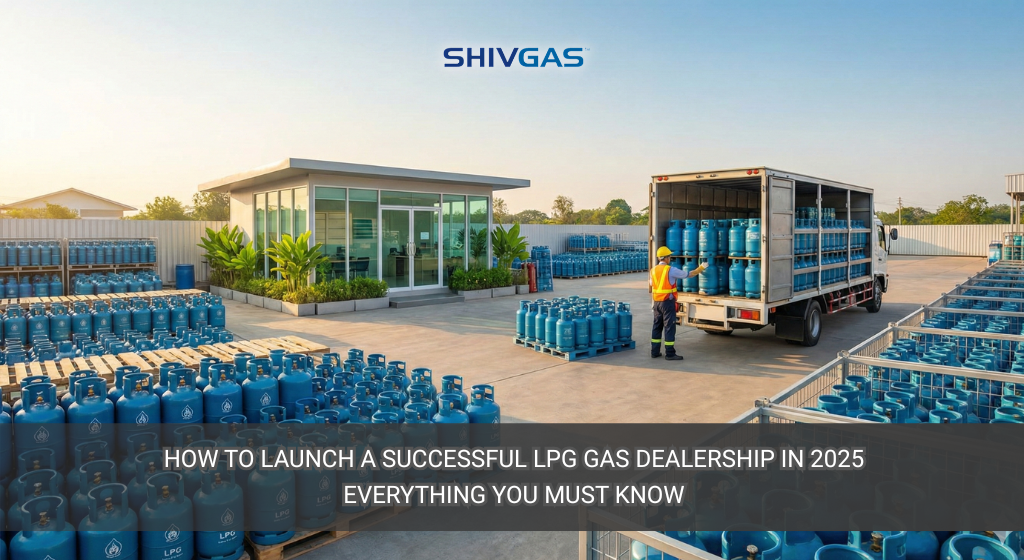
Planning to start an LPG dealership in 2025? It is probably one of the most practical business decisions you can make. India’s energy landscape is shifting, and consumers now expect faster service, transparent pricing, and flexible delivery operations. This is creating a strong opportunity for entrepreneurs like you to enter the sector through a private gas agency dealership, where the profit margins are competitive and the operational control is much higher than traditional PSU models.
As private LPG companies are gradually expanding their networks, they look for partners who can maintain safety standards, manage efficient distribution, and deliver a great customer experience. If you understand the regulations, financial requirements, and everyday operational challenges, you can build a dealership that is profitable from year one and scalable in the long run.
When you start your own private gas agency dealership, you partner directly with a private LPG company to distribute their cylinders in your assigned region. The procedures are not like PSU dealerships, which follow strict rules, fixed pricing, and a rigid operating structure. The private model gives you the flexibility in pricing, service style, delivery pattern, and customer acquisition.
You will no longer have to be limited to only domestic users. With a private dealership, you can supply LPG to restaurants, hotels, small industries, food outlets, caterers, and commercial establishments where demand is high and profit margins are significantly stronger. Many new entrepreneurs are already operating under this model because it allows quicker approvals, easier infrastructure setup, and a faster path to profitability.
To start a private gas agency dealership, you must meet some foundational criteria:
These are not rigid government rules, but standard requirements set by most private LPG companies for long term safety and business stability.
Even though it’s a private dealership, LPG handling is regulated by safety laws. Here are the licenses you must secure:
The Petroleum and Explosives Safety Organisation (PESO) must approve your LPG storage godown. It verifies safety of your infrastructure, location rules (distance from densely populated areas), fire protection, and cylinder handling.
This license is issued by the local fire department after they inspect extinguishers, sand buckets, ventilation, and emergency exits.
Depending on your city or district, you may need a trade license or municipality approval.
You must have valid ownership papers or a registered lease that proves you legally have the right to use the land for LPG storage.
LPG is a regulated commodity, so your investment goes primarily into safety-compliant infrastructure, cylinders, and operational assets. When you know exactly where your money is going, you can plan smarter and avoid unnecessary expenses.
Here’s how your initial investment is divided:
You’ll need a safe storage godown that meets PESO norms. The cost depends on whether you already own the land or need to lease it. The construction must follow fire-resistant standards, ventilation guidelines, and layout spacing rules. This becomes one of your primary investments because the godown is the storehouse of your dealership.
Most private LPG companies will require you to purchase a minimum number of cylinders for domestic, commercial, or industrial uses based on your territory size. The investment also includes regulators, valves, and testing procedures that the company mandates.
This includes:
These items may feel small in cost individually, but they are highly important for your agency’s safety and also for inspection approvals.
Depending on your supply volume, you may need two-wheelers for small deliveries, or mini-trucks for bulk supply. Delivery vehicles are what define your service speed. And faster delivery is where private dealerships outperform traditional PSU networks.
The working capital for your LPG dealership normally includes:
It is recommended to keep a buffer amount for 3–6 months so that you don’t face any service interruptions during the early phase of your dealership.
After the initial setup, you’ll have recurring costs such as:
Running an LPG gas agency dealership is not just about storing and supplying LPG cylinders. It’s also about equally managing your logistics operation. The better you plan these costs, the smoother your operations become.
A private gas agency dealership is a micro-logistics business. That means your location directly impacts delivery efficiency and customer satisfaction. Here’s how location can make a difference.
If your godown is strategically placed, your delivery routes become shorter. This means you can complete more deliveries in less time, reduce fuel costs, and keep customers happy with faster service.
Restaurants, hotels, and small industries form the highest-margin customer segment for private LPG. Choosing a godown near these clusters speeds up supply cycles and gives you a competitive advantage.
Although LPG storage itself must be away from crowded zones, your sales office or booking point can be located closer to residential and commercial areas. This dual-location model helps you stay compliant while still being accessible to your customers.
Safety is a mandatory requirement for every LPG dealership. In 2025, regulators have become even more strict, so you must follow every guideline without compromise.
Cylinders should never be rolled, dropped, or dragged. Trained staff must use trolleys, gloves, and correct lifting techniques. This protects the valves and reduces the risk of micro-leaks.
Full cylinders must be stored upright, in a well-ventilated zone, at a safe distance from empties. The space between them reduces pressure buildup and prevents accidents.
This seems obvious, but it’s one of the biggest causes of LPG accidents. Your godown must display clear “No Smoking” signage and enforce strict entry rules for staff and visitors.
As LPG is heavier than normal air, it settles low. That means your godown must have:
You must also be ready to respond instantly to any gas leak or ignition risk. That’s why your godown must always have certain fire safety protocols as well.
Dry Chemical Powder extinguishers are mandatory because they neutralize LPG fires faster than foam or water-based systems.
Sand buckets help contain small sparks and serve as a quick-control method during emergencies. Fire zones should be marked clearly and everyone should know where to gather or how to respond to such situations.
Your Fire NOC must be renewed. This inspection checks:
These inspections protect your dealership from legal risks and have a positive impression on customers that you are a reliable and trustworthy LPG dealership.
Starting a private gas agency dealership in 2025 is one of those business decisions that makes great sense. The demand for LPG is always on the rise, and customers want faster service, safer distribution, and more reliable suppliers. If you set up your dealership with proper approvals, follow safety rules, and keep your operations smooth, you’re already ahead of most competitors. At the end of the day, your success will come from doing the basics well. So, if you stay consistent, your dealership can become the go-to fuel source for homes, restaurants, and small businesses around you.
PESO approvals can take time, especially if your region has a high number of applications. The first thing you can do is to reach out to the inspecting officer and request a status update. Most delays happen due to missing layout documents, ventilation spacing issues, or incomplete fire-safety proofs.
Delivery delays usually happen when the demand curve spikes unexpectedly. The easiest way to handle this is by planning fixed delivery routes, scheduling refills in time blocks, and keeping at least one vehicle free for urgent drops. You can also assign customers specific time slots to reduce overload.
This is a common scenario for growing dealerships. Most private LPG companies allow emergency stock requests or temporary cylinder extensions if you show confirmed commercial demand. You can also maintain a small buffer stock for such opportunities.
Yes, relocation is possible, but it requires fresh approvals. You must reapply for PESO licensing, update your Fire NOC, and get your private LPG company’s formal approval. The new site must follow all distance rules and zoning requirements.
Your team must guide the customer to immediately turn off the regulator, open windows, avoid electrical switches, and move away from the area. Then, send a trained technician with a leak detector. If the leak is severe, the customer should be advised to exit the home and wait for assistance.



Comment (0)